Gentle Supine Yoga: How to Stretch Your Whole Body Without Ever Leaving the Floor
There's a particular kind of exhaustion that doesn't respond to rest alone. You lie down, but your body stays braced. Your breath stays shallow. Your hips and shoulders hold onto the day's tensions even as your mind tries to let go. What many people discover, often surprisingly, is that the most effective antidote isn't more effort — it's a different kind of attention. A slow, supported practice that meets your body exactly where it is.
Supine Yoga Practice
That's the invitation in a supine yoga practice: movement designed to stretch your entire body while the floor does the work of holding you. No balance demands, no standing effort, no negotiation with gravity. Just you, your breath, and the intelligence your body already carries when you give it the conditions to be heard.
The floor does something for your nervous system that standing practice can't quite replicate. When your back is fully supported, your body receives a signal it rarely gets during an ordinary day — that it is safe to release. Your nervous system begins to shift from its habitual alertness toward something quieter. This is why supine practices are so effective not just for flexibility, but for the kind of deep relaxation that restores rather than just pauses.
Rhoda Miriam's approach in this practice — rooted in her “Yoga for Slow Living” philosophy — treats breath not as a technique to perform but as the primary teacher. The practice opens with full yogic breathing, the kind that expands your ribcage in all directions rather than just lifting your chest. You might notice, as you settle into this, that your habitual breath is surprisingly partial — filling only the upper chest, bypassing the lower lungs entirely. Inviting breath into the belly and sides of the ribs doesn't just oxygenate the body more fully. It signals to the vagus nerve that the moment is safe, easing the nervous system in ways that no amount of willpower can manufacture.
From that foundation of breath, the practice moves through movements that address the body's most common holding patterns. Windshield wiper legs — the simple rotation of bent knees from side to side — release tension in the hips and outer thighs in a way that feels almost effortless, because the weight of the legs provides the opening rather than any muscular force. Arm circles and shoulder rotations restore mobility to joints that spend most of the day fixed in front-of-body positions. Gentle neck stretches release the cervical spine, which carries the cumulative tension of hours of looking at screens, driving, and simply holding your head upright against gravity.
Supine twists are perhaps the most underappreciated gift in a floor-based practice. When you draw one knee across the body and let gravity guide the rotation, your spine moves in a direction it rarely explores during daily life. The gentle compression and release that comes with spinal rotation also has a massaging effect on the digestive organs — a reminder that the body is not a collection of isolated parts but a whole system in which movement in one area creates ripple effects throughout.
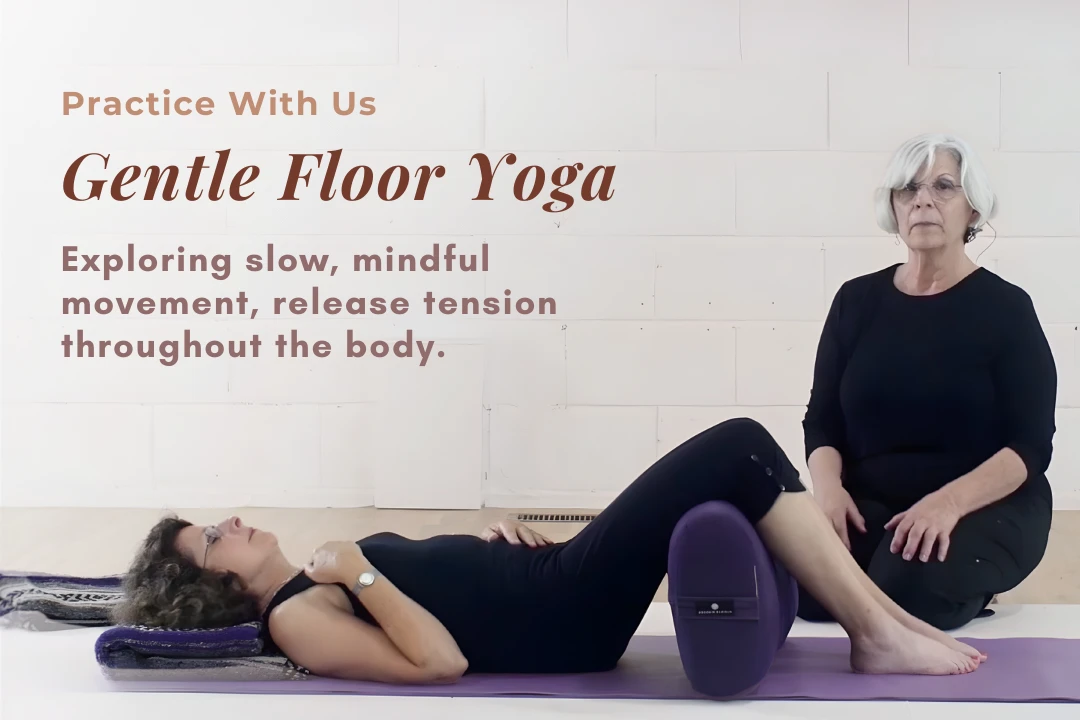
Props make the difference between a practice that asks you to work and one that lets you receive. A blanket folded beneath the sacrum for the supported backbend tilts your pelvis slightly, allowing the front of your body to open without any muscular effort. A bolster under the knees relieves low back tension during floor poses. These aren't accommodations for people who can't do the “real” version of something. They're the real version — tools that allow your body to actually release rather than simply endure.
What Rhoda's practice teaches, ultimately, is that slowing down is itself a skill. Most of us move through exercise, even yoga, in a mode of accomplishment — checking off movements, managing discomfort, pushing through. A supine practice asks something different: to stay curious about what you actually feel, breath by breath, moment by moment. That shift from doing to noticing is where the deepest change happens.
Watch Rhoda guide you through the full practice below.

Also, read...
The Year I Joined the SuperAgers (Well, Sort Of ..)
Do You Suffer from Tin Man Syndrome?
330 Billion Cells a Day: Your Body’s Internal Renewal Process and What Trips It Up
Related courses
Join Our Age Strong Community – More Courses Coming Soon!
How Not to Be Present: Understanding the Power of Mind and Consciousness
Yoga for Flexibility: Fascia, Flow, and Metabolic Efficiency