Bow Pose: How to Build Backbending Strength Without Letting Your Body Take Shortcuts
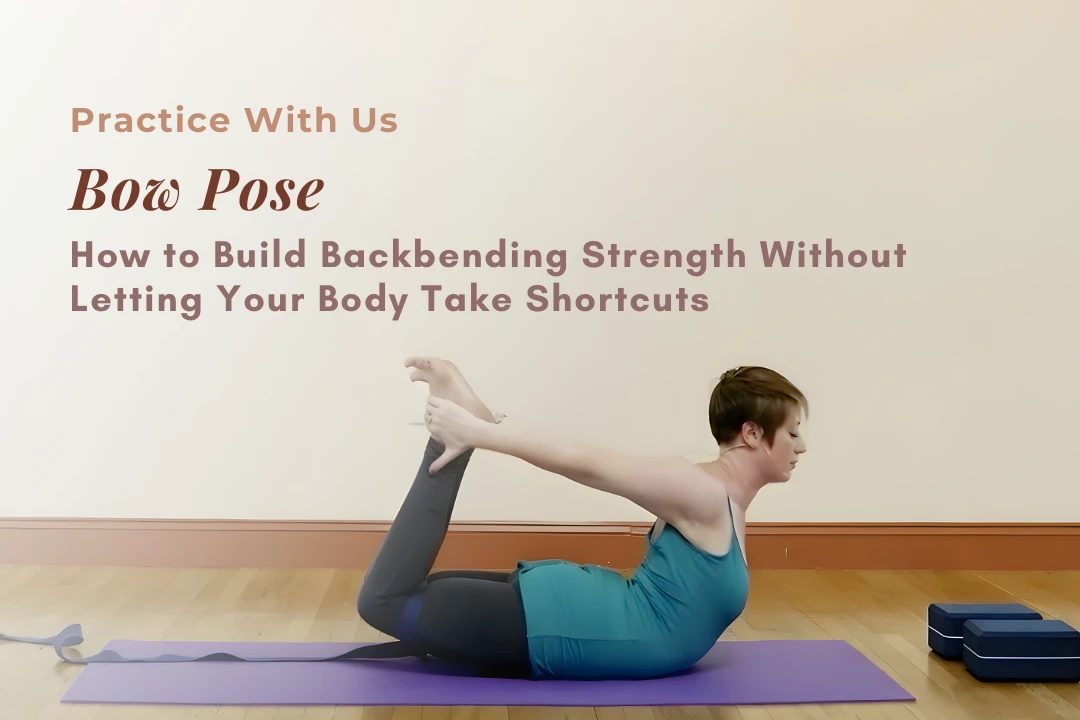
Bow Pose has a reputation as one of yoga's most satisfying heart openers — the kind of pose that, when it works, leaves your chest feeling cracked open and your back body humming with effort. But getting there requires something most instruction skips entirely: understanding why your body naturally resists the shape Dhanurasana is asking for, and what to do when it finds an easier path instead.
That easier path is almost always the same. When the challenge of keeping your legs together becomes too much, your knees drift wide. It feels like effort — like you're working hard — but the spread is actually a release of tension, not a building of it. Your lower back stops doing the job it needs to do, your chest doesn't lift the way it should, and the pose loses the quality that makes it worth practicing in the first place. Kate Heffernan puts it plainly: left unattended, our bodies will always take the path of least resistance.
Props change that equation — not by making the pose easier, but by making the right version possible. A yoga strap looped around your ankles creates an external boundary that your legs push into, keeping them from drifting and giving your back muscles something real to work against.
The result is a version of Bow Pose where the effort goes exactly where it belongs: into lifting your chest first, then driving your feet toward the ceiling to create the full arc of the shape. For those who find a strap uncomfortable at the knee, a block placed between your inner thighs just above the knee changes the equation in the opposite direction — instead of pushing away from a constraint, you're squeezing toward something, which activates the same stabilizing muscles through a different pathway.
Both approaches teach the same essential sequence of actions that Dhanurasana actually requires. You push your feet into your hands to initiate the chest lift. Then, only once the front body is opening, do you send the feet skyward to complete the bow. When that order gets reversed — when people kick up before the chest has risen — the lower back takes the strain that the whole back body should be sharing. The prop variations make it much harder to skip that sequence, because they create feedback your body can actually feel.
This isn't about modifying the pose into something lesser. It's about practicing the full expression of it in a way your nervous system can learn from. Bow Pose practiced with honest alignment builds the back strength and chest opening it promises. Bow Pose practiced with compensations just reinforces the compensations.
Watch Kate Heffernan guide you through both variations in the full tutorial below.
Want more pose tutorials that prioritize sustainable strength over surface-level effort? Subscribe to our YouTube channel for new videos every week.
Also, read...
The 3+1 Pillars of Healthy Aging: Are You Missing the Most Vital Component?
Can Simple Stretching Help Fight Cancer? The Groundbreaking Research of Dr. Helene Langevin
Beyond Bone Density: The Missing Elements in Fracture Prevention
Related courses
Join Our Age Strong Community – More Courses Coming Soon!
How Not to Be Present: Understanding the Power of Mind and Consciousness
Yoga for Flexibility: Fascia, Flow, and Metabolic Efficiency