Standing Forward Bend: Finding Length Without Losing Your Back
Standing forward bend shows up in nearly every yoga class, which is exactly why so few people ever really learn it. When a pose is repeated that often, it starts to feel like something you already know — a transition, a rest stop, a moment to breathe before the next thing. But if your lower back has ever complained after a forward fold, or your hamstrings have felt more strained than stretched, that's your body telling you something important is missing. The good news is that it isn't flexibility. It's a single principle that changes everything about how this pose works.
Most people fold forward the way you'd bow — by rounding from the spine, curving the upper back, letting the head drop toward the floor. It feels like folding. But for your body, it's actually closer to compression. When the movement initiates from your spine rather than your hips, your vertebrae and the soft tissue surrounding them absorb the load instead of your hamstrings.
What the pose is actually asking for is a hip hinge — a rotation of your pelvis over the heads of your femur bones that allows your spine to travel forward as one long, decompressed unit. The difference between these two movements is subtle to the eye and dramatic to the back. And the way you learn to feel it is through Ardha Uttanasana, the Halfway Lift. When you rise to a flat back with your hands on your shins and your chest parallel to the floor, you're not just pausing mid-fold — you're teaching yourself exactly what it feels like when your hips are doing the work. From there, folding forward simply continues that same action.
Guiding You Through Standing Forward Bend
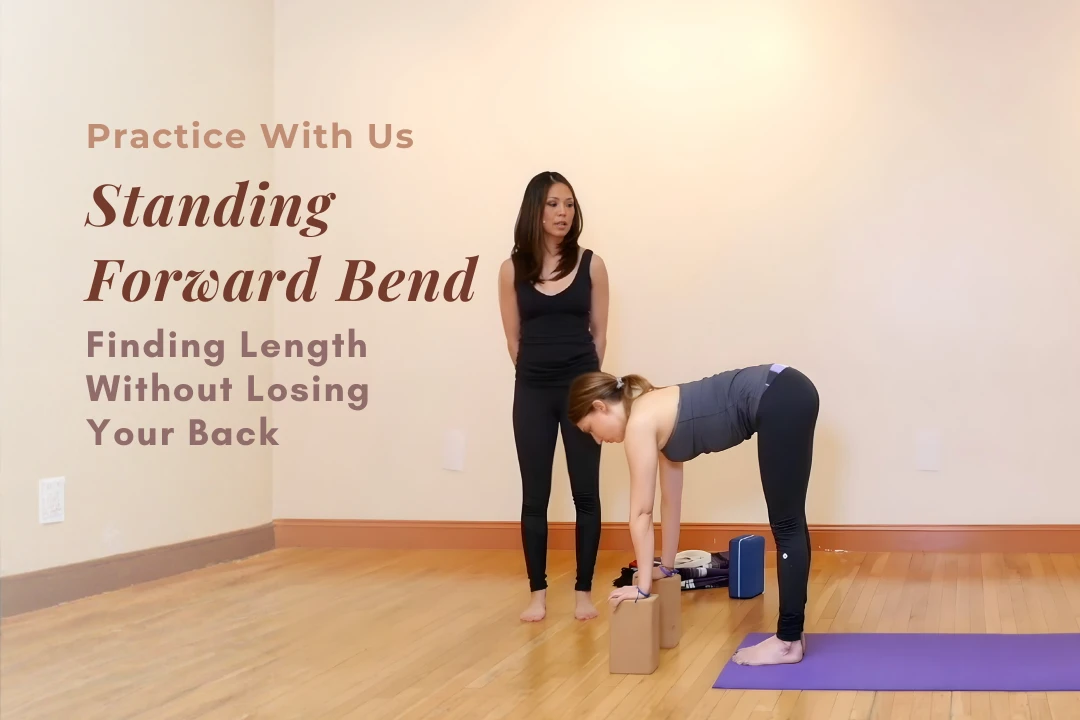
In this tutorial, Jasmine Punzalan walks you through both movements with the kind of attention that lets you actually feel the distinction rather than just hear it described. She covers where your weight belongs — in the balls of your feet, not falling back into your heels, which affects how freely your hamstrings can lengthen. She shows you how bending your knees generously, enough for your belly to rest on your thighs, isn't a shortcut around the pose but the condition that allows your spine to decompress fully.
Blocks under your hands bring the floor to you so you can maintain that length without forcing range you don't yet have. And she's clear about the difference between the productive pull of a hamstring stretch and the warning signal of strain in your lower back — a distinction worth understanding before the next time your class moves through a forward fold without pausing to explain it.
The deeper shift this tutorial offers isn't about going deeper. It's about understanding that Uttanasana isn't a hamstring exercise you endure — it's a spinal traction pose that happens to stretch your hamstrings along the way. When the hinge comes from your hips and your spine travels forward as one connected length, the pose stops feeling like something you're surviving and starts feeling like something your body genuinely wants.
Watch Jasmine Punzalan guide you through the full tutorial below.
If protecting your spine while building real flexibility is something you're working toward, subscribing to the YogaUOnline YouTube channel means you'll never miss a tutorial that helps you understand the why behind the movement — not just the shape.