Seated Spinal Twist: How to Rotate Your Thoracic Spine Without Cranking Your Lower Back
There's a version of Seated Spinal Twist that feels genuinely therapeutic — a deep, satisfying release through the whole torso that leaves you breathing more freely and standing a little taller. And then there's the version most people actually do, where the lower back absorbs all the rotation and the thoracic spine — the part that actually needs to move — stays largely locked in place. The difference between the two isn't effort. It's understanding where the twist is supposed to come from.
The spine isn't uniform. Your lumbar vertebrae, in the lower back, are built for stability and load-bearing, not rotation — they have very little rotational range by design. Your thoracic spine, through the mid-back and ribcage, is where rotation is meant to happen. When you crank a twist without this awareness, you're asking your lumbar spine to do a job it wasn't designed for, which is exactly how a pose meant to be therapeutic becomes a source of SI joint irritation and lower back strain. The goal of a seated twist isn't to see how far you can rotate — it's to mobilize the segments of your spine that have been stiffened by hours of sitting, while leaving the vulnerable ones alone.
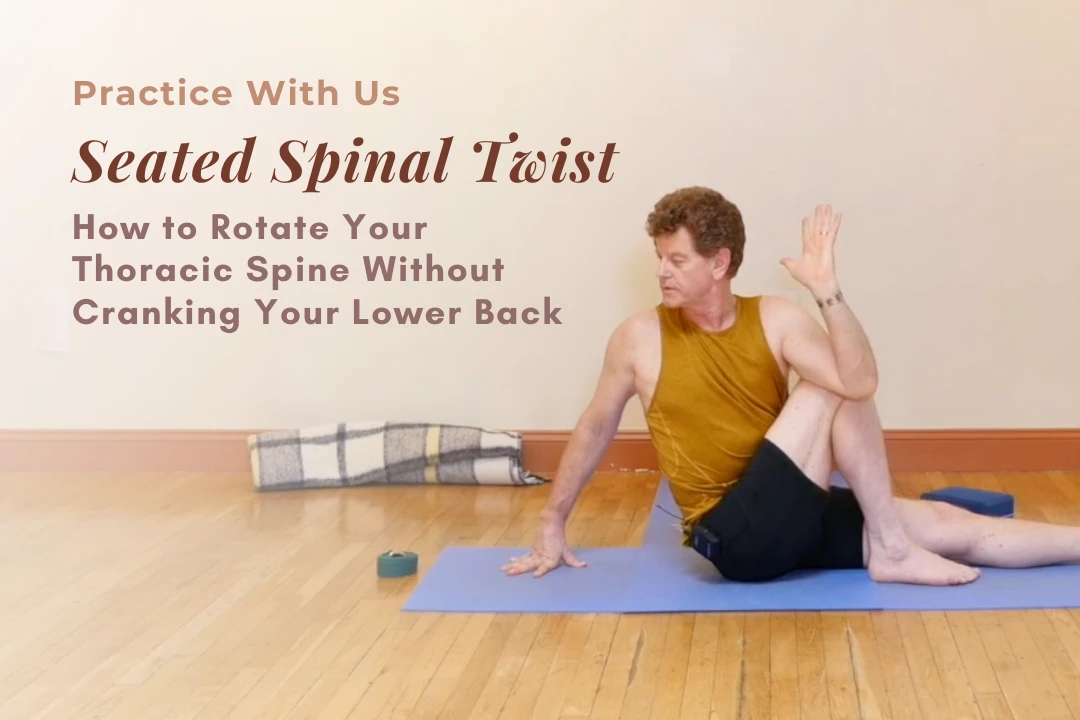
In this tutorial, Doug Keller walks you through Ardha Matsyendrasana — Half Lord of the Fishes — with the kind of anatomical clarity that makes the difference between these two experiences immediately felt. He begins with the foundation: both sitting bones grounded, spine lengthened upward before any rotation begins. That length isn't just preparation — it's what creates the space between vertebrae that allows the thoracic spine to rotate freely rather than compress.
Seated Spinal Twist from your Ribcage
From there, Doug teaches you to initiate the twist from your ribcage rather than muscling through with your arm. The arm becomes a lever for refinement, not the engine of the pose. He covers how to use a folded blanket under one sitting bone when the pelvis tilts, how breath naturally deepens the rotation without forcing, and the common habit of collapsing the chest mid-twist that undoes the work of the whole setup.
What this tutorial makes clear is that Seated Spinal Twist, practiced with this level of attention, isn't a general-purpose stretch — it's targeted mobilization of exactly the part of your spine that governs posture, breathing, and how freely you can move through your day. When the thoracic spine rotates as it's meant to, the ripple effect reaches further than the pose itself: shoulders release, breath deepens, and the lower back — finally freed from a job it was never supposed to do — can simply rest.
Watch Doug Keller guide you through the full tutorial below.
If spinal health and intelligent movement are what keep you coming back to your mat, Doug's channel is worth following — subscribe for more tutorials that show you not just what to do, but exactly why it works.