

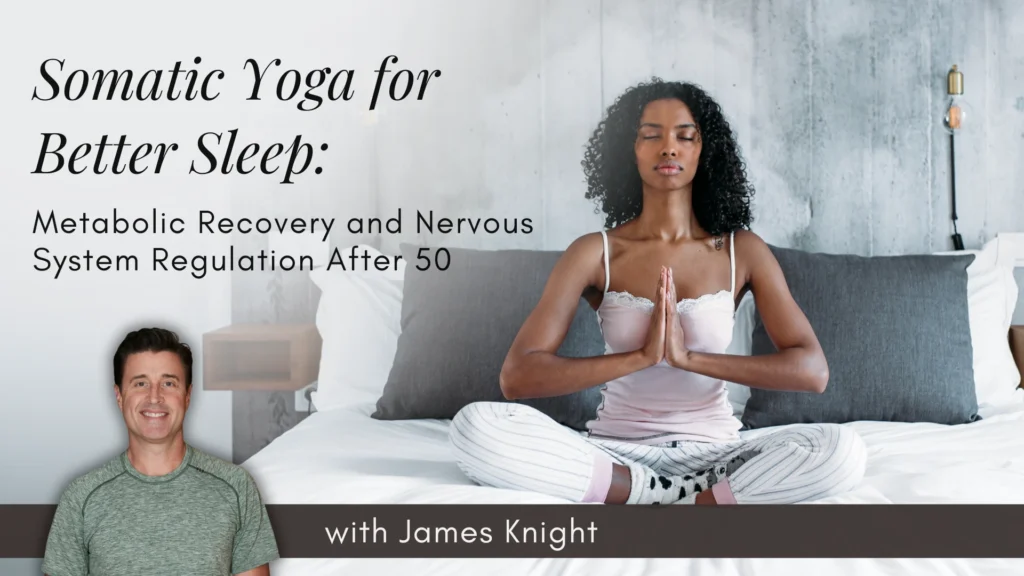
Wednesdays, June 3, 10, 17 & 24, 2026
3 pm ET / 12 pm PT
Join Us Live or View the Recordings!
After 50: Why Sleep Matters More
After 50, sleep becomes more than rest—it becomes a key regulator of muscle preservation, glucose metabolism, and hormonal balance.
Research shows that age-related changes in muscle signaling can make strength gains and tissue repair less efficient over time. While the stimulus for growth begins during movement and resistance training, it is processed and integrated during deep sleep—particularly during slow-wave cycles when growth hormone release supports protein synthesis and cellular repair.
When deep sleep is disrupted:
- Muscle repair becomes less efficient
- Inflammatory markers may rise
- Insulin sensitivity can decline
- Glucose regulation becomes more fragile
Even short-term sleep restriction has been shown to measurably impair metabolic flexibility.
The Missing Link: Nervous System Regulation
Yet what is often overlooked is this:
The nervous system determines whether the body can access restorative sleep states at all.
Many adults carry decades of subtle muscular guarding and low-grade sympathetic activation. The body may be tired—but the nervous system has not fully downshifted.
Rather than stimulating the system further, this approach works neurologically—helping normalize muscle tone, support vagal regulation, and create the internal conditions necessary for deeper sleep and metabolic integration.
What Makes This Approach Distinct
Traditional “bedtime yoga” often focuses on stretching, but James Knight’s somatic method works at a deeper neurological level. These aren’t poses you hold—they’re movement explorations that retrain your nervous system’s habitual patterns. Many people over 50 carry decades of compensatory movement patterns and chronic muscle guarding that create a constant low‑level stress signal, keeping the body in sympathetic (fight‑or‑flight) dominance even when you’re trying to rest.
The somatic approach uses three key principles:
- Pandiculation: The natural contraction‑release pattern you see in animals stretching, which helps reprogram muscle length at the brain level.
- Slow, mindful movement: Speed and intensity trigger arousal; slowness signals safety to your nervous system.
- Internal attention: Shifting from “doing” to sensing, which activates the parasympathetic (rest‑and‑digest) system.
In this four-session livestream series, participants will explore:
- How nervous system regulation creates the conditions for deeper, more restorative sleep.
- The relationship between muscle tone, autonomic balance, and metabolic efficiency.
- Why pandiculation resets muscular patterns more effectively than static stretching.
- How somatic awareness shifts the body from sympathetic dominance toward parasympathetic regulation.
- Practical tools to improve restorative capacity—whether expressed as deeper sleep, more efficient recovery, or sustained daytime vitality.
Sleep is one expression of restoration. But restoration begins with regulation.
Through slow, mindful somatic movement explorations, participants learn to reduce chronic contraction patterns that subtly signal threat to the brain. As the nervous system experiences safety, the body becomes more capable of entering hormonal and metabolic states associated with repair and recalibration.
Educational Focus and Outcomes
By Week 4, participants will not only understand the connection between sleep, muscle, and metabolism—they will have embodied tools to:
- Improve self-regulation.
- Support metabolic resilience.
- Enhance recovery following strength training.
- Develop greater trust in their own somatic rhythms and somatic intelligence.
This series is designed for yoga teachers, therapists, healthcare professionals, and adults interested in longevity who wish to integrate nervous system science with practical, compassionate somatic tools.
Gentle Somatic Yoga® is a form of neuromuscular re-education grounded in the science of sensory motor learning. The practice emphasizes internal awareness—helping participants identify areas of sensory motor amnesia (habitual, unconscious muscular holding) and gradually restore voluntary control. The emphasis is on exploration over performance and internal sensing over external achievement—guiding participants to rely less on imitation and more on embodied self-trust.
Join Us Live or View the Recordings!
Wednesdays, June 3, 10, 17 & 24, 2026
3 pm ET / 12 pm PT
