How to Make Savasana Actually Restful: The Two-Blanket Setup for Neck and Lower Back Support
Savasana has a reputation as the easy part — the reward at the end of class where you simply lie down and rest. But if you've ever spent those final minutes quietly negotiating with your neck, or noticed your lower back lifting away from the mat in a way that makes stillness feel tense rather than peaceful, you already know that lying down is not the same as letting go. For many people, Savasana is the pose where the body is most honest about what it actually needs.
The Spine has its own Geometry
The reason so many people struggle in Corpse Pose isn't a lack of relaxation skills — it's that the spine has its own geometry, and when nothing is supporting that geometry, your muscles quietly keep working to compensate. Your cervical spine has a natural inward curve at the neck, and your lumbar spine has one at the low back.
When you lie flat on a mat without support, both of those curves hang unsupported in the air, and the surrounding muscles stay subtly engaged to manage that gap. That low-level effort is exactly what prevents the nervous system from fully downshifting into the kind of rest that Savasana is meant to offer.
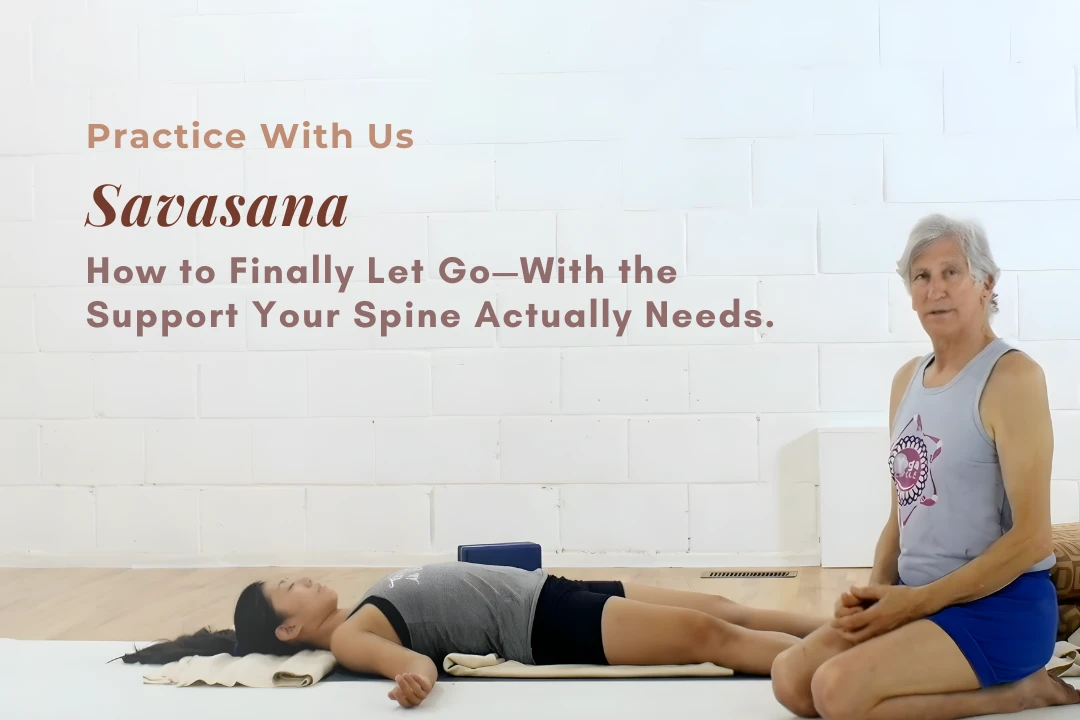
In this tutorial, Gabriel Halpern introduces a precise two-blanket method that gives your spine the support it needs to genuinely release. The first blanket is folded and positioned so that it extends from your shoulders up to just behind the mastoid process — the small bone behind your ear — preserving the neck's natural curve rather than flattening or straining it.
The second blanket is placed under the lumbar region, sized to fit only the space between your floating ribs and your pelvic rim, which allows your lower back to soften into neutral while your hips stay grounded on the mat. Once your spine is properly held, Gabriel guides you through a three-cycle facial relaxation practice that moves through your face in thirds — from brow to scalp, from eyes to nose, from mouth to jaw — and gradually draws awareness inward, first to the inside of the skull and then all the way around the circumference of your head.
It's a Systematic Process
It's a systematic process, not a suggestion to simply relax, and that distinction matters: the body responds to structure even in rest.
What this setup makes possible is a Savasana where the work is actually finished — where you're not managing discomfort or maintaining effort beneath the surface. The blankets aren't a modification for people who can't do the pose properly; they are what proper Savasana looks like for a spine that deserves real support.
Gabriel's approach treats this final posture with the same therapeutic attention as any other pose in the practice, because integration — the settling of everything you've moved and breathed through — only happens when the body genuinely feels safe enough to stop holding on.
Watch Gabriel Halpern guide you through the full tutorial below.
If deep rest and nervous system renewal are part of your practice, subscribe to the YogaUOnline YouTube channel — where you'll find more restorative tutorials designed to help your body find the stillness it's actually looking for.

Also, read...
Seated Spinal Twist: How to Rotate Your Thoracic Spine Without Cranking Your Lower Back
Eagle Pose: How to Find Your Balance Without the Tangle
Sun Salutation: How to Practice Vinyasa Without Stressing Your Wrists or Shoulders
Related courses
The Psoas Connection: Core Stability for Movement, Breath & Digestion
Yoga for Back Care and Spinal Mobility: A 4-Part Practice Series
Optimizing Your Breath: Yogic Breath for Cellular Vitality