Eagle Pose: How to Find Your Balance Without the Tangle
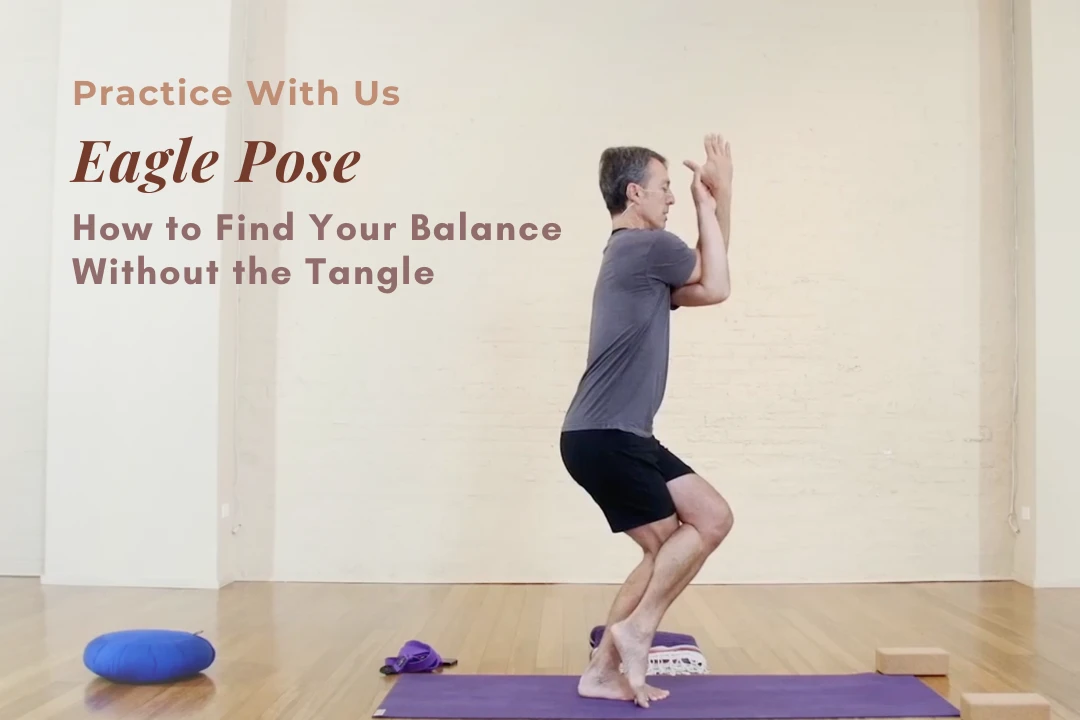
Eagle Pose has a reputation for being one of those poses that either clicks immediately or leaves you feeling like you've tied yourself in a knot. The wrapping of arms and legs, the single-leg balance, the simultaneous demands on your hips, shoulders, and nervous system — it's a lot to manage at once. But the reason most practitioners struggle with Garudasana isn't insufficient flexibility or poor balance. It's that they try to build the full shape before they've established the foundation it depends on.
Balance in Eagle Pose — and in any single-leg standing pose — lives in your bent standing knee. Lowering your center of gravity by bending deeply into that knee brings you closer to the ground and gives your body a stable platform before any wrapping begins. This is the principle that changes everything: the pose isn't a test of how completely you can wrap, it's an exploration of how well you can organize your body around a single point of support. Once that foundation is solid, the layers of the pose — the crossed thigh, the hooked foot, the wound arms — become additions to something stable, rather than complications layered onto something shaky.
Eagle Pose from the ground up
In this tutorial, Baxter Bell walks you through Eagle Pose with a build-it-from-the-ground-up approach that makes this notoriously complex pose genuinely accessible. He starts with the standing leg, teaching you to find your balance point before crossing anything. For the leg wrap, he's refreshingly direct about the foot hook: if your top foot doesn't reach behind the standing calf, resting it on the floor or against your standing leg isn't a lesser version of the pose — it's the version that lets your body actually work.
The arms follow the same logic, with Baxter clarifying the often-confusing question of which arm goes under (same side as the leg on top) and offering clear options if your palms don't meet. He also illuminates what the arm position is actually doing: creating a deep stretch across the upper back and between the shoulder blades that directly counters the rounded, forward shoulder posture that builds from hours at a desk.
What Eagle Pose offers, practiced this way, is more than a balance challenge. It's a full-body reset — hips lengthened, upper back opened, nervous system engaged — organized around the simple act of finding your center. The pose doesn't require a perfect shape. It requires honest, grounded attention to where you actually are.
Watch Baxter Bell guide you through the full tutorial below.
If you're rebuilding your relationship with balance poses one steady foundation at a time, subscribe to the channel — there's a whole library of tutorials that meet you where you are and show you how far that actually gets you.

Also, read...
Eagle Pose: How to Find Your Balance Without the Tangle
Sun Salutation: How to Practice Vinyasa Without Stressing Your Wrists or Shoulders
The Psoas: The Most Important Muscle You’ve Probably Never Heard Of
Related courses
The Psoas Connection: Core Stability for Movement, Breath & Digestion
Yoga for Back Care and Spinal Mobility: A 4-Part Practice Series
Optimizing Your Breath: Yogic Breath for Cellular Vitality