Head-to-Knee Pose: Lengthen Your Spine Without Straining Your Back
The name Head-to-Knee Pose sets almost everyone up for the wrong goal. Head-to-Knee Pose (Janu Sirsasana) sounds like an arrival point — get your head down, task complete. So you fold forward, round your back, and feel your hamstrings protest while your spine quietly takes the strain. What the pose is actually asking for is something else entirely: a long, unhurried hinge from your hips that keeps your back in its natural shape while your spine reaches out over your extended leg. The distance your head travels is almost beside the point.
Head-to-Knee Pose and the Hip-Hinging Principle
The misunderstanding that makes this pose feel frustrating — or even painful — is treating it as a stretch you achieve by collapsing forward rather than lengthening forward. When you round from your mid-back to close the gap, your hamstrings barely register the work. Your spine absorbs it instead. The shift Jasmine Punzalan teaches is to hinge from the hip crease — the fold point at the very top of your thigh — so the movement originates where it's meant to. You may fold less deeply this way. That's not a limitation. It means the stretch is landing where it belongs.
What Jasmine Covers in This Tutorial
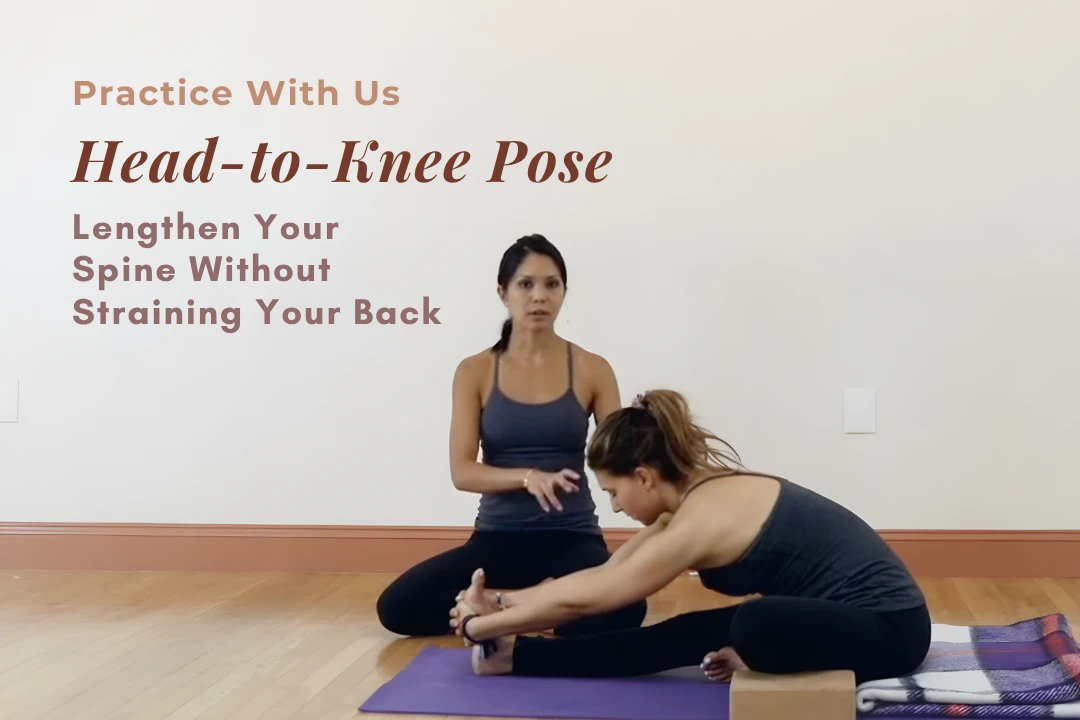
Jasmine begins with the foundation that makes everything else possible: sitting on a folded blanket. That small lift beneath your hips allows your pelvis to tilt forward more easily, so your spine can reach out rather than curl under. Your bent knee drops toward the floor, with the sole of your foot resting against your inner thigh. Your extended leg stays active — toes pointing upward, the leg engaged rather than passive. If reaching your foot isn't available yet, a strap around the sole keeps you connected without pulling your back into a curve. Jasmine also walks through how to use your breath to sequence the fold — inhaling to lengthen, exhaling to deepen — and addresses something most tutorials skip: the asymmetry. Most people have one side that's noticeably tighter, and understanding that helps you approach each side without comparison or frustration.
The Principle That Travels With You
What makes this tutorial worth returning to is that hip-hinging isn't specific to Head-to-Knee Pose. It's the same organizing principle behind every seated forward fold you'll ever practice. Once you feel the difference between folding from your hips and collapsing from your spine, you won't be able to unfeel it. That awareness becomes a reference point — something your body carries into Seated Forward Bend, Wide-Legged Forward Fold, and even how you pick something up off the floor.
Watch Jasmine Punzalan guide you through the full tutorial below.
If understanding why a pose works changes how it feels in your body, Jasmine's channel is worth your time. Subscribe to YogaUOnline on YouTube for forward fold tutorials that build real flexibility — starting with your hips, not your back.