Slow Chair Yoga: How to Increase Your Range of Motion Without Leaving Your Seat
There's a reason for exploring slow chair yoga. There's a particular kind of stiffness that accumulates quietly. You reach for something in the back seat and realize your spine won't rotate the way it used to. You try to check your blind spot while driving and feel the resistance in your neck. You bend to tie a shoe and notice your hips have opinions about that. None of this is dramatic — it just shows up one day as a limitation where there used to be ease.
This is exactly what a range-of-motion practice is designed to address, and a chair becomes one of the most intelligent tools available for doing it. Seated movement isn't a compromise for people who can't get to the floor — it's a specific environment that allows your spine and hips to move through their full range with stability underneath you and no fear of losing your balance. That sense of safety is what allows genuine mobility work to happen.
What makes Rhoda Miriam's approach distinct is her “Yoga for Slow Living” philosophy, which is less an instruction and more an invitation. Moving slowly isn't about being gentle in a limiting way — it's about creating the conditions for you to actually feel what's happening inside your body as it moves. Most of us rush through stretches, pushing toward a destination, missing the information available along the way. Slowing down makes the practice far more intelligent and considerably more effective.
Slow Chair Yoga
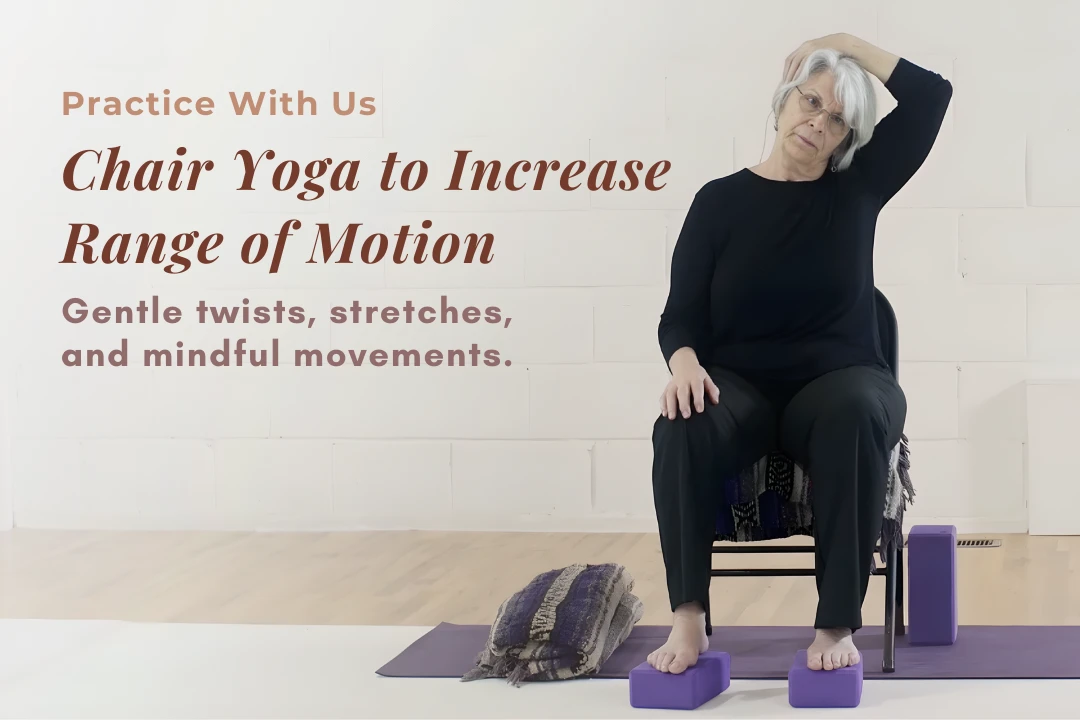
In this practice, Rhoda guides you through a sequence designed to open the places that tend to close first. The cervical spine — your neck — holds a remarkable amount of tension that most people have stopped noticing because it's become their baseline. Seated neck stretches with coordinated arm movements help you discover where that tension actually lives and begin to create space there. The lateral body follows: seated side bends holding your wrist create a kind of traction through the side body that's difficult to achieve any other way, lengthening the spaces between your ribs and releasing the muscles along your spine that pull you toward one side.
The spinal twist is where the practice becomes most precise. Rhoda teaches the progression from the ground up — initiating rotation from the hips first, then allowing it to travel through the mid-back, then the shoulders, and finally the head. This sequence matters because it's the only way to access true spinal rotation rather than just turning your head and calling it a twist. Organ stimulation, spinal decompression, and the health of your intervertebral discs all depend on this kind of full, progressive rotation — and most people have never been taught how to find it.
The hip work follows a similar logic. Seated leg lifts lubricate the hip joints in a way that feels almost immediately different from static stretching — movement feeds the joint, distributing synovial fluid into spaces that sitting all day tends to compress. The figure-4 hip opener, practiced on both sides with a forward fold, reaches the gluteal muscles and outer hip in a way that directly translates to easier walking, climbing stairs, and getting up from a chair. These aren't abstract yoga poses. They're the mechanics of your daily life.
The reframing insight here is simple but worth sitting with: range of motion isn't something you either have or don't have. It's something your body is continuously recalibrating based on how you use it. Every time you move deliberately through your full available range — slowly, with attention, coordinated with breath — you're teaching your nervous system that this range is safe and available. That's what this practice is building, one session at a time.
Watch Rhoda guide you through the complete practice below.
Want more chair yoga practices designed to support your mobility and ease of movement as you age? Subscribe to our YouTube channel for new videos every week.