The Psoas: The Most Important Muscle You’ve Probably Never Heard Of
The psoas muscle may be the most important muscle you've never heard of
How the Psoas Quietly Shapes Your Gut, Your Stress, Your Breath — and Your Aging…
One of the most profound truths in human physiology is also one of the least appreciated:
Nothing in your body works in isolation.
Every muscle, nerve, organ, and system is in constant conversation with everything else. Pull on one thread, and the whole fabric shifts. Which means that when something goes wrong — or right — the effects ripple far beyond where you might expect.
Nothing illustrates this better than a muscle well known in yoga circles, yet deeply misunderstood by most people — including most yoga practitioners.
It’s called the psoas muscle (pronounced so-az). And once you understand what it actually does, you’ll never think about your body the same way again.
So, What Is the Psoas Muscle?
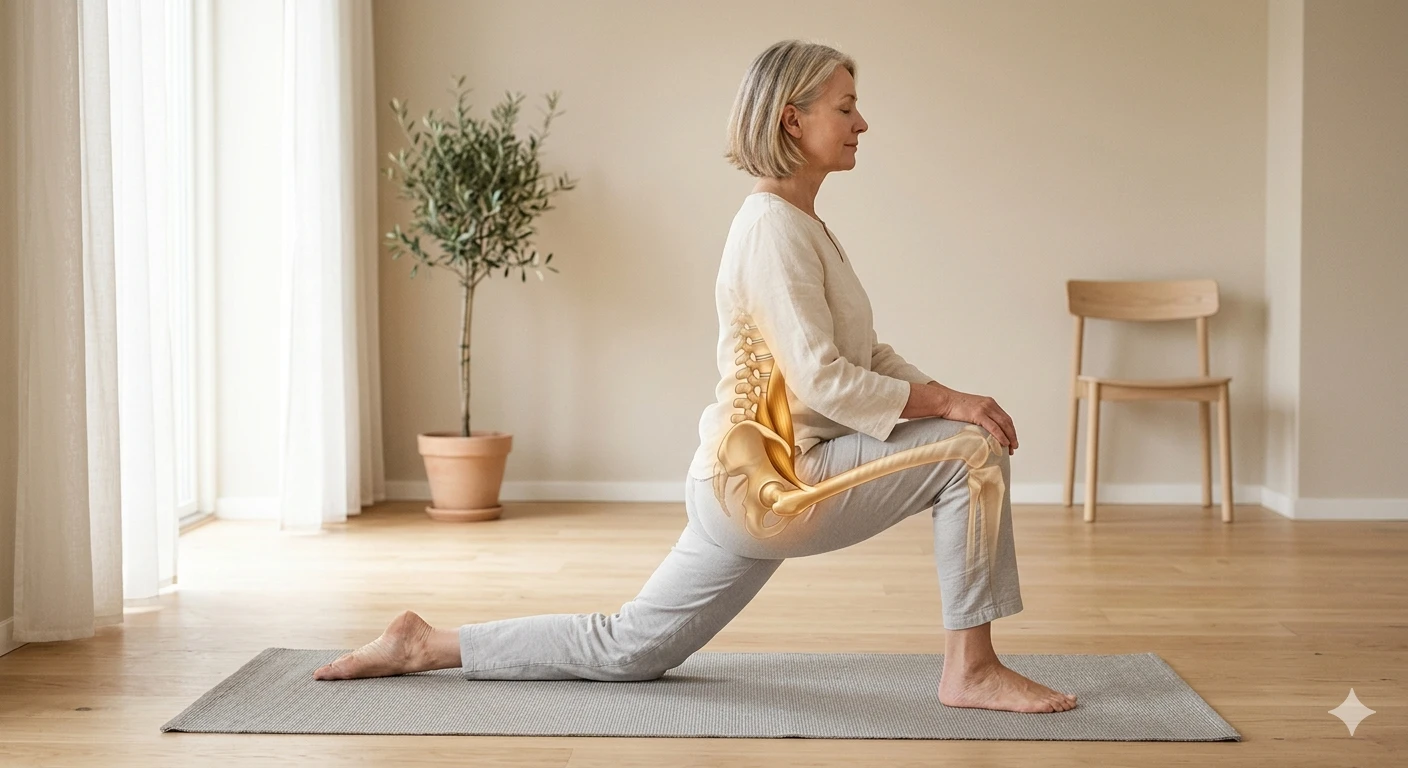
Picture a thick, ribbon-like muscle running deep inside your torso — one on each side of your spine. It starts just below your ribcage, travels down alongside your spine, crosses over the front of your pelvis, and attaches to the top of your thigh bone (femur).
Along the way, it crosses eight separate joints. Eight.
The Cleveland Clinic describes the psoas as “a bridge in the center of your body that connects lots of parts and helps you perform motions that use your abdomen and legs at the same time.”
It’s a hip flexor, yes — it lifts your leg, helps you get out of a chair, and is essential for walking, climbing stairs, and running. But that’s the small story. Here’s the big one.
The Body Keeps the Score — And the Psoas Keeps the Tally
Before we dive into the three surprising functions of the psoas, we need to talk about something that shapes all of them: stress. Specifically, what stress does to your body over time.
Dr. Bessel van der Kolk is one of the world’s leading trauma researchers and the author of The Body Keeps the Score — one of the most important books written about human health in the last 30 years. His central insight is both simple and revolutionary:
“Traumatized people chronically feel unsafe inside their bodies: The past is alive in the form of gnawing interior discomfort. Their bodies are constantly bombarded by visceral warning signs… They learn to hide from their selves.”
— Dr. Bessel van der Kolk, The Body Keeps the Score
Van der Kolk’s work shows that the body doesn’t just experience stress — it holds it. Memories of stress, fear, and overwhelm are encoded not just in the brain, but in muscle tension, posture, and the nervous system itself. The body, he argues, is always keeping score.
Dr. Stephen Porges, whose landmark Polyvagal Theory transformed how we understand the nervous system, adds another crucial layer. His research shows that our nervous system is constantly scanning the environment for cues of safety or danger — a process he calls “neuroception.” As Porges puts it: “How safe we feel is crucial to our physical and mental health and happiness.”
When we feel unsafe — even at a low, chronic level — our nervous system shifts out of its calm, social engagement mode and into a state of defense. And there is one muscle at the very center of that shift.
The psoas.
1. The Psoas Is Affecting Your Stress Response — Whether You Know It or Not
Here’s something that may change the way you think about stress forever.
The psoas is your body’s primary fight-or-flight muscle. When your nervous system detects a threat — whether it’s a physical danger, a stressful work situation, an anxious thought, or even just a packed to-do list — the psoas contracts. In response, it curls you protectively inward, bracing you for action and preparing you to run, fight, or freeze.
This is not a metaphor. It is anatomy.
According to yoga therapist and trauma researcher Leila Stuart, when the nervous system activates fight-or-flight, “safety through mobilization — running away or fighting — is enabled by activating the main muscles associated with this strategy: the psoas muscles.” Even before a threat fully registers consciously, the psoas is already responding.
In the short term, this is brilliant design. The psoas is doing exactly what millions of years of evolution prepared it to do.
The problem is chronic stress.
Most of us are not running from predators. Instead, we are living with persistent, low-level stress — the kind that never fully lets up. Financial pressure. Relationship strain. The endless scroll of bad news. The body doesn’t distinguish well between a tiger and a threatening email. The nervous system reads both as danger.
And so the psoas never fully releases.
Day after day, it stays contracted — just slightly, just enough — and that sustained muscular tension sends a continuous signal back to the brain: we are still in danger.
As a result, the brain keeps the stress response active. More cortisol. More inflammation. Reduced digestion. Disrupted sleep. A body that never quite makes it into recovery mode.
When the Psoas Never Lets Go
This is precisely what van der Kolk and Porges have been pointing to for decades. Van der Kolk writes that trauma survivors are “vulnerable to a host of medical illnesses and chronic pain syndromes, insomnia, drug and alcohol addiction, depression, obesity, and other issues related to optimal functioning of the entire organism.”
Many of these patterns begin in the body itself — in the muscular and nervous system loops that keep the alarm bells ringing long after the threat is gone. Furthermore, Porges’ Polyvagal Theory explains the mechanism: when the nervous system cannot find safety, it stays in a defensive state, and the body’s repair and recovery functions — immunity, digestion, cellular repair, hormonal balance — are all suppressed.
Here’s the empowering flip side.
When you consciously, skillfully release the psoas, the reverse cascade begins…
The muscle softens. In turn, the brain receives a different signal. The nervous system begins to interpret the environment as safe. And the body can finally shift into the parasympathetic state — rest, digest, repair, and recover — that it has been starved of.
This is why yoga, done in the right way, is so much more than stretching. It is a direct intervention in the body’s stress and safety signaling system — with the psoas at the very center of that work.
2. The Psoas Has a Profound Impact on Your Digestive Health
The impact of the psoas on the stress response is just one part of the picture. Here’s the part that surprises almost everyone — including people who’ve practiced yoga for years.
The two psoas muscles run directly alongside your digestive tract. Each sits in immediate contact with the ascending colon on the right side of your body and the descending colon on the left. In other words, they’re neighbors sharing the same anatomical real estate.
But it goes even deeper than that.
The lumbar plexus — the network of nerves that controls gut movement, bowel function, and signals between the gut and the brain — is actually embedded within the psoas muscle itself. These nerves run through the psoas on their way to and from the digestive organs.
Think about what that means.
When your psoas is chronically tight — which it is in most adults who sit for long periods, carry stress in their bodies, or have lost flexibility over time — it does two things to your gut. First, it mechanically compresses the intestines, reducing the space they need to move food through properly. Second, it places pressure on those embedded nerves, disrupting the signals that keep digestion running smoothly.
The downstream effects are ones most of us know all too well: bloating, sluggish digestion, bowel irregularity, and the general sense that your gut just isn’t working right — even when your diet is good.
As van der Kolk writes: “Angry people live in angry bodies.” We might add: stressed bodies live in tight psoas muscles — and tight psoas muscles create unhappy guts.
The gut and the psoas aren’t just neighbors. They’re in constant, direct conversation. And most of us have never been taught to listen to what they’re saying to each other.
3. The Psoas Shapes Every Breath You Take
You may have read that the diaphragm is the most important muscle in the body. It is the primary engine of every breath you take, the regulator of intra-abdominal pressure, the muscle with more connections to the brain and nervous system than almost any other.
But here’s what most people don’t know: the psoas and the diaphragm are physically joined.
This is not a loose or indirect connection. The diaphragm’s tendons attach to the spine at almost the exact same points where the psoas begins. Moreover, the two muscles share a continuous fascial connection all the way through the core. The diaphragm’s medial arcuate ligament — one of its key anchoring structures — is actually a tendinous arch in the fascia of the psoas major itself.
In 2006, researcher Carriere concluded that “psoas spasm may influence diaphragmatic mechanics, and conversely that abnormal tensions in the medial arcuate ligament of the diaphragm may irritate the psoas.” In other words, these two muscles influence each other constantly — in both directions.
The NIH anatomy reference puts it plainly: the psoas “seems able to exert influence on the balance of the dynamics of respiratory function and the functional relationship between the diaphragm and the pelvic floor.”
What does this mean in daily life?
What This Means for Your Daily Breathing
When your psoas is chronically tight, it pulls on the diaphragm. That restriction limits how fully the diaphragm can descend with each breath. The result is shallower, more restricted breathing — what we often call chest breathing. And shallow breathing, as most yoga practitioners know, keeps the nervous system in a state of low-level activation. It’s both a symptom and a driver of the stress response.
As senior integrative pelvic health physical therapist Aimee Lake explains, because the psoas connects to the diaphragm via fascia, “it kind of connects breathing and walking.” Every step you take, every breath you draw, involves the psoas — whether you’re aware of it or not.
This is why breath-focused yoga that also works the psoas isn’t just relaxing. It is functionally recalibrating two of the most important muscles in your body at the same time.
And There’s a Fourth Connection — The Pelvic Floor
If the psoas connects upward to the diaphragm, it also connects downward — all the way to the pelvic floor.
Anatomy researcher Gibbons described it this way: “The diaphragm’s medial arcuate ligament is a tendinous arch in the fascia of psoas major. Distally, the psoas fascia is continuous with the pelvic floor fascia.”
The whole system forms what researchers call the “abdominal canister” — with the diaphragm as the lid, the pelvic floor as the base, and the psoas as a key structural pillar running through the middle.
This is a profound connection with real, everyday consequences…
Bladder control. Bowel function. Core stability. Pelvic organ support. Sexual health. The ability to bear down or let go. All of these functions are directly influenced by the health and tone of the psoas, through its fascial connections to the pelvic floor.
Research has shown that a tight psoas can pull the pelvis into an anterior tilt — and that this misalignment puts direct strain on the pelvic floor muscles, causing them to either over-tighten or lose the ability to engage properly. Weakness in the psoas, on the other hand, reduces the deep core stability that the pelvic floor depends on.
For women especially — and for everyone navigating the changes that come with aging — this connection is profound. And largely invisible. Very few practitioners are trained to see it, let alone address it.
Which brings us to someone who has spent her entire career doing exactly that.
This Is Where Leslie Howard Comes In
Leslie Howard is not just a yoga teacher. She is one of the most respected yoga therapists in the world — and arguably the foremost expert on yoga for pelvic floor health practicing today.
As the author of Pelvic Liberation, a groundbreaking book on pelvic floor health and yoga, Howard has designed and conducted research studies with UCSF, trained hundreds of yoga teachers in the nuances of pelvic floor anatomy and therapy, and helped thousands of students find relief from incontinence, pelvic pain, prolapse, and pelvic floor dysfunction through the intelligent, evidence-informed application of yoga and breathwork.
With over 3,500 hours of advanced yoga study and certification as a Yoga Therapist (C-IAYT) through the International Association of Yoga Therapists, her work is recognized by both Yoga Alliance and the National Certification Board for Therapeutic Massage & Bodywork.
But what makes Leslie truly rare is not just her credentials. It’s her ability to see the whole system — to understand how the psoas, the pelvic floor, the diaphragm, the breath, the nervous system, and the gut are all part of one interconnected web. And to translate that understanding into practices that actually change how people feel in their bodies.
The Psoas Connection: A Four-Week Series
In April, Leslie is bringing all of that expertise into Age Strong for Life with The Psoas Connection — a four-week live online series that works on all of these systems at once. The series includes targeted psoas release and strengthening work, breath practices that restore the psoas-diaphragm relationship, gut-stimulating sequences that work through the body’s anatomical connections, and pelvic floor integration — the piece most yoga series completely overlook.
This is the kind of rare, integrative teaching that most yoga practitioners never encounter in a lifetime of classes — because there are very few teachers in the world who can connect these dots the way Leslie Howard can.
Curious to learn more? Check out Leslie’s course on YogaUOnline!
Five Yoga Poses to Begin Releasing Your Psoas
The good news: the psoas responds beautifully to patient, mindful practice. These five poses are a wonderful starting point. Move slowly, breathe deeply, and let each pose be an invitation — not a demand. The psoas, remember, is deeply wired to your nervous system. The more relaxed and safe you feel, the more it will let go.
1. Constructive Rest Pose (Savasana with Bent Knees)
This is one of the most effective psoas releases there is — and it requires nothing but gravity and time.
Lie on your back with your knees bent and your feet flat on the floor, hip-width apart, about 12–16 inches from your sitting bones. Let your arms rest alongside your body, palms down. Close your eyes. Do nothing.
When your knees are bent at this angle, the psoas is neither stretched nor contracted — it’s completely off duty. Gravity gently coaxes it to release, often after 5–10 minutes of simply resting here. You may notice a softening sensation deep in the front of the hip or lower abdomen. That’s the psoas letting go.
Stay for 5–15 minutes. Breathe slowly and naturally. Notice the weight of your body sinking into the floor.
2. Low Lunge (Anjaneyasana)
Perhaps the most direct psoas stretch in yoga — and one of the most important.
From hands and knees, step your right foot forward between your hands, aligning the ankle below the knee. Lower your left knee to the floor (place a blanket under it if needed). Stack your hands on your right thigh and press down gently to create length through your core. Soften the front of the left hip and breathe. For a deeper stretch, sweep both arms overhead.
The back leg’s psoas is the primary muscle being lengthened here. The key is not to push for depth — instead, relax the front of the back hip completely and let the breath do the work. Each exhale is an invitation for the psoas to release a little more.
Stay for 5–10 slow breaths. Repeat on the other side.
3. Supine Figure-Four Stretch (Supta Kapotasana)
A gentle, deeply effective way to release the psoas and the surrounding hip structures — especially for anyone with tight or sensitive hips.
Lie on your back with both knees bent, feet flat on the floor. Cross your right ankle over your left thigh, just above the knee. Flex your right foot to protect the knee. Either stay here, or gently draw both legs toward your chest by interlacing your hands behind your left thigh. Breathe into the outer right hip and the deep front of the right hip socket.
This pose works the psoas indirectly by releasing the surrounding hip rotators and flexors that often hold tension in tandem with it. It’s also wonderfully calming for the nervous system — making it doubly effective for psoas release.
Stay for 8–10 breaths. Repeat on the other side.
4. Supported Bridge Pose (Setu Bandha Sarvangasana with a Block)
A beautiful blend of passive psoas release and gentle strengthening — and one of the most restorative poses in the yoga toolkit.
Lie on your back with knees bent and feet flat on the floor, hip-width apart. Press your feet into the floor and lift your hips. Slide a yoga block under your sacrum (the flat triangular bone at the base of your spine) — start with the lowest height and adjust from there. Let your pelvis rest heavily on the block and allow everything to soften.
The mild extension of the hips in this pose creates a gentle, passive lengthening of the psoas without any muscular effort. At the same time, the glutes and hamstrings are gently engaged — and strengthening the glutes is one of the best ways to counterbalance a tight psoas over time, as the two muscle groups are functional opposites.
Stay for 1–3 minutes. Breathe slowly and let gravity do the work.
5. Legs Up the Wall (Viparita Karani)
Simple, deeply restorative, and profoundly effective — especially for releasing the chronic, stress-related psoas tension we’ve been discussing throughout this article.
Sit sideways next to a wall, then swing your legs up as you lie back. Your legs rest against the wall, your back is on the floor. You can place a folded blanket under your hips for extra support. Let your arms rest out to the sides, palms up. Close your eyes and breathe.
This pose reverses the habitual shortening that comes from sitting and standing all day, allowing the psoas and hip flexors to completely let go. More importantly, it activates the parasympathetic nervous system — the rest-and-digest state — which, as we’ve seen, is precisely what the psoas needs to truly release. The body can’t fully let go while it still feels under threat. This pose signals safety at a physiological level.
Stay for 5–15 minutes. This is a practice, not just a pose.
A note on all five poses: the psoas is not a muscle you can force open. It responds to patience, breath, and — most importantly — a sense of safety. If you approach these poses with gentleness and genuine curiosity about what you’re feeling, you’ll get far more out of them than if you push for sensation. Think of each session as a conversation, not a confrontation.

Also, read...
The Psoas: The Most Important Muscle You’ve Probably Never Heard Of
Extended Hand-to-Toe Pose: How to Build Toward Full Expression Without Losing Your Balance
Forearm Balance: Finding Your Vertical Line Without the Shoulder Risk
Related courses
The Psoas Connection: Core Stability for Movement, Breath & Digestion
Yoga for Back Care and Spinal Mobility: A 4-Part Practice Series
Optimizing Your Breath: Yogic Breath for Cellular Vitality

Recent articles
The Psoas: The Most Important Muscle You’ve Probably Never Heard Of
Extended Hand-to-Toe Pose: How to Build Toward Full Expression Without Losing Your Balance
Forearm Balance: Finding Your Vertical Line Without the Shoulder Risk
Categories
Tags
- breath and yoga
- constructive rest pose
- digestive health yoga
- fight or flight
- hip flexor
- legs up the wall
- Leslie Howard
- low lunge
- nervous system yoga
- pelvic floor
- polyvagal theory
- Psoas
- psoas muscle
- psoas release
- restorative yoga
- Yoga Anatomy
- yoga and stress
- yoga for women over 50
- yoga therapy
- YogaUOnline