Wall-Supported Balance Practice: Finding Stability Without the Struggle
Balance poses have a reputation for being humbling. You stand on one leg, you wobble, you come out early — and somewhere in the back of your mind you start to wonder whether this is just something your body isn't built for. What that story misses is that balance isn't a fixed trait you either have or don't. It's a skill that depends on feedback — your standing leg talking to your core, your core organizing your pelvis, your gaze anchoring your nervous system. When any part of that chain is unclear, the whole system wobbles. The wall doesn't take the work away from you. It gives your body the reliable feedback it needs to learn what stability actually feels like.
When you practice a standing pose with one hand lightly touching a wall, you're not cheating the pose — you're giving your nervous system something to reference while the deeper work of balance actually develops. That light touch of fingertips on a surface tells your brain where you are in space, which frees your standing leg and core to do their job without the added noise of anxiety about falling. Over time, that internal sense of organization becomes something you carry into the middle of the room. The wall is the teacher, not the crutch.
Wall-Supported Sequence
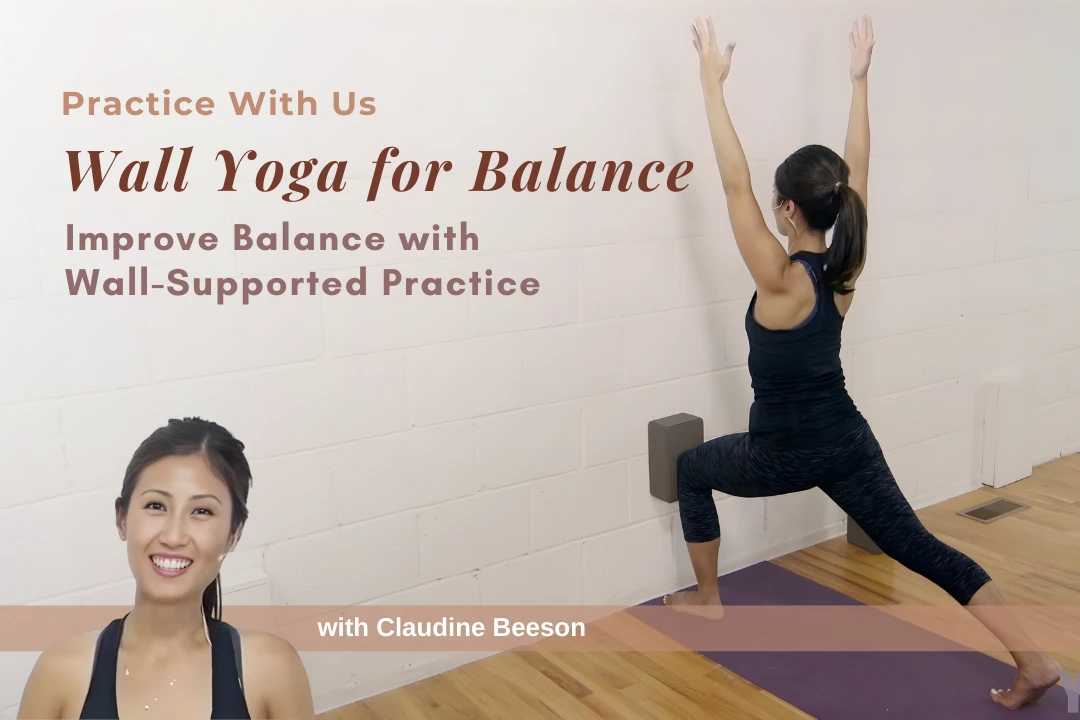
Claudine Beeson guides you through a complete wall-supported standing sequence using two blocks and a strap. She opens with a standing forward fold at the wall to release the hamstrings and create length through the back of the body, then moves through low lunge and high lunge variations with a block at the wall — where she covers the hip and knee alignment that makes these poses both safe and genuinely strengthening. Tree Pose and Warrior One follow, with Claudine showing exactly how wall contact changes what you can feel in your standing leg and back foot. She also includes a hip flexor balance — pressing the knee into a block while finding height in the spine — that builds the kind of core engagement standing poses depend on, and closes with a strap-assisted hamstring stretch that lets you explore range of motion without compromising your balance entirely.
This isn't a practice for days when everything feels easy. It's a practice for every day — for the mornings when balance is off, for the weeks after illness or disruption, for the long stretch of building something real in your body rather than just hoping it shows up on demand. Claudine is clear about this: the wall is valuable any day your balance isn't quite there, at any level of practice. What you're building here isn't just steadiness in the pose. It's the internal architecture that makes steadiness possible.
Watch Claudine Beeson guide you through the full tutorial below.
If building real, lasting balance in your standing practice is something you're working toward, Claudine's channel offers the clear, props-informed teaching that makes that progression feel achievable. Subscribe to keep that work going.
Also, read...
Wall Sun Salutation: Use the Wall for Better Alignment & Balance
Standing Forward Bend: Finding Length Without Losing Your Back
Seated Spinal Twist: How to Rotate Your Thoracic Spine Without Cranking Your Lower Back
Related courses
The Psoas Connection: Core Stability for Movement, Breath & Digestion
Yoga for Back Care and Spinal Mobility: A 4-Part Practice Series
Optimizing Your Breath: Yogic Breath for Cellular Vitality