Easy on the Knees: How to Build Strength and Mobility When Your Joints Need Extra Care
How can we be easy on the knees? If knee pain has quietly started shaping your yoga practice -changing which poses you attempt, how long you stay in them, or whether you show up on the mat at all- you're not alone. For many people over 50, the knees become the defining factor in what feels accessible and what feels like a risk. The common response is to back off, modify less, or simply avoid anything that loads the joint. But here's what that approach misses: the knees don't get more stable by being left alone. They get more stable by being moved intelligently.
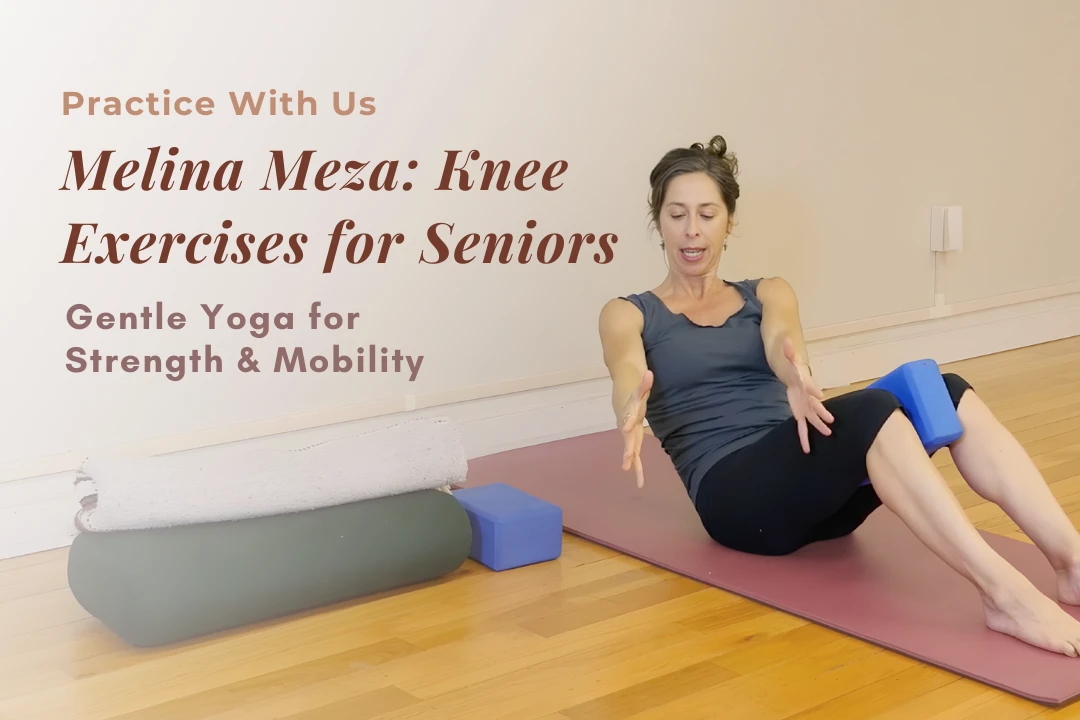
This is the insight at the heart of Melina Meza's 44-minute class for anyone navigating knee injuries, hypermobility, post-surgical recovery, or the general sensitivity that tends to arrive with age. The premise isn't to protect your knees by doing less. It's to protect them by understanding how strength, alignment, and joint tracking actually work together — and then building from there.
The knees are what biomechanists call a “middle joint” — they're largely dependent on what happens above and below them. When your hips are weak, or your inner thighs can't engage properly, or your quads can't absorb load smoothly, the knee ends up compensating for all of it. This is why knee pain so often has nothing to do with the knee itself. Strengthening the muscles that surround and support the joint — particularly the quadriceps, hamstrings, and inner leg — is what creates genuine, lasting stability rather than just symptom management.
How Can We be easy on the knees?
Melina approaches this not by avoiding challenging poses but by rethinking how you enter and inhabit them. Wall-supported Chair Pose, for example, becomes a precision tool for building quad and knee stability rather than a pose that simply loads the joint. Warrior One and Warrior Two include block modifications that help you track the knee correctly over the foot — a small adjustment that changes the entire mechanical picture. Triangle Pose offers a block wedge technique specifically for anyone with knee hypermobility, addressing a common vulnerability that standard alignment cues often overlook entirely.
The class also moves through supine leg work with a strap, inner leg strengthening in Downward Dog and Plank, Bridge Pose variations with block support, and a restorative wall sequence — all sequenced to build strength progressively without overloading the joint at any single point. Props aren't used here as a workaround for people who “can't do” the poses. They're the mechanism through which the poses actually work for your body.
What makes this practice genuinely useful is the reframe it offers: a knee that needs care isn't a knee that needs rest. It's a knee that needs smarter movement. The difference between a practice that aggravates the joint and one that rehabilitates it often comes down to whether you understand why each modification exists — what it's protecting, what it's building, and how it's changing the load your body is learning to manage.
Watch Melina guide you through the full practice below.
Want more yoga practices designed for joint health and healthy aging? Subscribe to our YouTube channel for new videos every week.