Half Moon Pose: Finding Stability Without the Chaos
Balance poses have a way of revealing something uncomfortable: that effort alone isn't the same as control.
Half Moon Pose — Ardha Chandrasana — is one of yoga's most visually striking standing postures, and also one of the most frequently misunderstood. The instinct, when you feel yourself tipping, is to grip harder, reach further, muscle through. But that grasping is usually what's causing the instability in the first place. The pose isn't asking for more effort. It's asking for better information.
What most people don't realize is that Half Moon is actually several things happening at once: your hip rotating open, your chest turning toward the ceiling, your top arm extending skyward, all while your standing leg holds everything aloft. When you attempt all of that simultaneously without knowing what each part is supposed to feel like, the pose feels chaotic because it is — there are too many unknowns stacked on top of each other.
The Solution
The solution isn't to practice falling and catching yourself more often. It's to understand each element of alignment in isolation, so that when you bring them together, your body already knows what it's looking for.
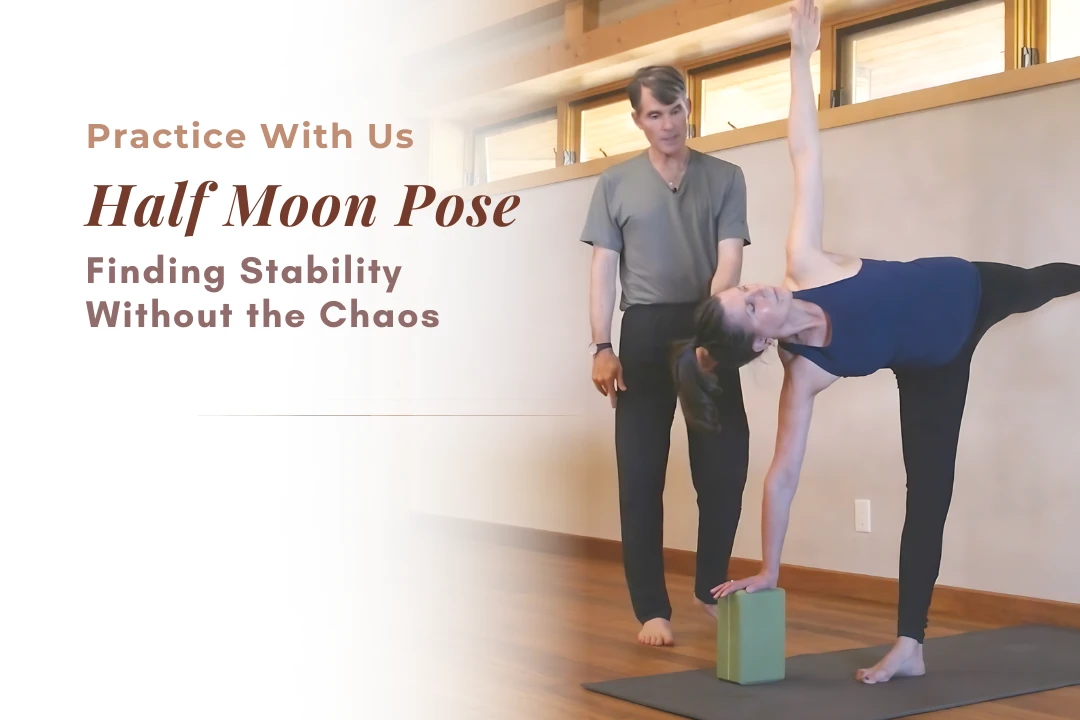
That's exactly what Tias Little does in this tutorial. Working with your back to the wall, you get immediate, honest feedback about whether your hips, shoulders, and head are actually in one plane — because the wall tells you the truth when your proprioception might not.
A block under your bottom hand brings the floor close enough that you can focus on opening rather than desperately reaching downward, which is what collapses the pose for most people. From there, Tias guides you through the actions that create genuine stability: grounding firmly through your standing foot, engaging the glute of your standing leg to anchor the whole structure, and stacking your top hip directly over your bottom hip so your pelvis is rotating open rather than sagging.
How to Exit the Pose
He also covers how to enter the pose from Triangle or Warrior II, when to keep your gaze toward the floor for better balance versus when lifting your eyes becomes possible, and how to exit with the same control you brought into it.
The wall and the block aren't training wheels you'll eventually discard. They're feedback tools that teach your nervous system what the pose actually feels like when it's working — and once your body knows that feeling, it can begin to find it without the support. That's not a simpler version of Half Moon. That's how understanding gets built into the body, the only kind that holds when you're standing on one leg.
Watch Tias Little guide you through the full tutorial below.
If you want to stop white-knuckling your way through standing balances and start understanding what actually creates stability, subscribe to the YogaUOnline YouTube channel — where complex poses are broken down into something your body can genuinely learn.