Can Simple Stretching Help Fight Cancer? The Groundbreaking Research of Dr. Helene Langevin
A Scientist Who Sees the Whole Body

What if one of the most powerful tools against cancer were something you already do in your yoga practice?
Dr. Helene Langevin is a physician-scientist whose career has been shaped by a single, elegant idea: that the body's connective tissue — the web of fascia, ligaments, and soft tissue that links every organ, muscle, and bone — is not mere biological packing material. It's an active, responsive system that plays a central role in health and disease.
Trained at McGill University and Johns Hopkins, Dr. Langevin spent more than two decades studying how connective tissue responds to mechanical forces like stretching and acupuncture. She directed Harvard's Osher Center for Integrative Medicine before being appointed Director of the National Center for Complementary and Integrative Health (NCCIH) at the National Institutes of Health, a position she held from 2018 to 2025. She is now joining the Osher Center for Integrative Health at the University of Vermont to continue her research.
Her work has always centered on a question with deep relevance for yoga practitioners: what actually happens in our tissues when we stretch?
The 2018 Study: 10 Minutes of Stretching Shrank Tumors by Half
In 2018, Dr. Langevin and her team at Harvard and Brigham and Women's Hospital, in collaboration with Dana-Farber Cancer Institute, published a study in the journal *Scientific Reports* that turned heads in both the cancer and integrative medicine worlds.
The researchers knew from earlier work that gentle daily stretching could reduce inflammation and scar tissue (fibrosis) in connective tissue. They also knew that the tissue surrounding a tumor — called the stroma — plays a powerful role in whether cancer grows or stays dormant. Fibrosis in the stroma acts almost like scaffolding that helps a tumor take root, connect to blood vessels, and grow. So they asked a bold question: could stretching change the tissue environment enough to slow cancer growth?
What They Did
Sixty-six female mice received injections of breast cancer cells into their mammary tissue. The mice were then randomly divided into two groups: one group was gently stretched for 10 minutes a day over four weeks, and the other received no stretching. The stretching protocol involved gently lifting each mouse by the tail while its front paws grasped a bar — a position similar to a full-body extension. With minimal training, the mice held this position comfortably and without signs of distress.
No other cancer treatments were given. This was stretching and stretching alone.
The Results Were Remarkable
After four weeks, tumors in the stretching group were **52% smaller** than tumors in the non-stretching group. That's not a small effect — the tumors were less than half the size, from gentle stretching alone, with no drugs, radiation, or surgery.
But the story didn't end with tumor size. The researchers wanted to understand *why* stretching had such a dramatic effect, so they looked at what was happening inside the animals' immune systems.
Stretching Woke Up the Immune System
They found two key changes in the stretched mice:
- Immune cells became more active against the cancer. Stretching increased levels of interferon-gamma (IFN-γ), a critical signaling molecule in the body's cancer-fighting (cytotoxic) immune response. Stretched mice also had more IFN-γ-producing CD4+ T-cells at the tumor site. Even more striking, the stretch group showed lower levels of PD-1 on their CD8+ T-cells. PD-1 is an immune “checkpoint” — when it's elevated, it's a sign that the immune system has become exhausted and has stopped fighting the cancer. Lower PD-1 meant the immune system was still actively battling the tumor.
- Inflammation was being properly resolved.
The stretch group had significantly higher levels of Specialized Pro-Resolving Mediators (SPMs), specifically resolvins D1 and D2. These are natural molecules the body makes to wind down inflammation once it's done its job. This is critical because while some inflammation is needed to fight cancer, chronic, unresolved inflammation actually *feeds* tumor growth.
As Dr. Langevin put it: “Inflammation is a double-edged sword in cancer. Although it is an essential component of all immune responses, it needs to be limited both in location and duration”.
In other words, stretching appeared to do something extraordinary: it helped the body *turn up* its cancer-fighting immune response while simultaneously *turning down* the chronic inflammation that helps cancer thrive. To the research team's knowledge, no one had previously linked inflammation resolution to immune cell recovery from exhaustion.
A Yoga Connection
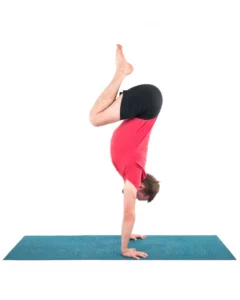
The researchers themselves noted the yoga connection. The full-body stretch used in the mouse model — with both hind limbs and forelimbs simultaneously extended — mirrors core components of many common yoga poses used with cancer patients. They suggested these yoga poses “could be a good starting point for developing a stretching protocol to be tested in humans”.
The 2025 Follow-Up: A Better Model, Even Bigger Implications
Seven years later, in January 2025, Dr. Langevin's team published a follow-up study that addressed the earlier study's most significant limitation — and produced findings that may be even more exciting for yoga practitioners.
The Problem with the First Study
While the 2018 results were striking, the study had an acknowledged weakness. The mice were held by their tails during stretching, which meant a researcher was physically handling them. This raised a reasonable question: were the anti-cancer benefits truly from the stretching itself, or could the handling and mild stress of being restrained play a role? As the original authors honestly noted, they “cannot rule out that mild stress may have contributed to the beneficial effect”.
This question needed to be answered before the research could advance toward human trials.
A Groundbreaking New Approach: Voluntary Stretching
To solve this problem, Yi He, Lisbeth Berrueta, and Dr. Langevin developed something entirely new — the **first-ever preclinical voluntary stretching model**. Instead of being handled by researchers, the mice stretched on their own in their home cages.
The team cleverly designed the cages so that food, water, and enrichment items were positioned to encourage mice to reach and extend their bodies — essentially self-stretching. Using a sophisticated 24/7 video monitoring system (Noldus PhenoTyper), the researchers tracked every stretch over a two-week period to confirm the mice were actually stretching regularly.
This eliminated the handling variable entirely. If the mice were stretching themselves, any anti-cancer effect could be attributed to the stretching, not to stress or researcher contact.
Stretching vs. Running: A Head-to-Head Comparison
The 2025 study added another important element: a direct comparison between stretching and running. Using the MET-1 breast cancer model in FVB mice, the team assigned animals to one of three groups: voluntary stretching, voluntary wheel running, or a control group with neither.
The results:
– Voluntary stretching significantly inhibited tumor growth — confirming the 2018 finding with the improved, handling-free model.
– Stretching was just as effective as running at reducing tumor size. This is a remarkable finding, because running is a much more intense form of exercise. For cancer patients who may not have the energy for vigorous aerobic exercise, knowing that gentle stretching may deliver comparable anti-cancer benefits is profoundly encouraging.
Different Movements, Different Mechanisms
Perhaps the most fascinating finding was what the team discovered when they analyzed blood proteins. Using plasma proteomic analysis, they found that stretching and running activated completely different protein profiles in the blood.
This means stretching is not simply a mild form of aerobic exercise. It appears to fight cancer through its own distinct biological pathways — potentially involving the connective tissue and fascial mechanisms that Dr. Langevin has spent her career studying. The details of these protein differences are still being mapped, but the implication is clear: stretching brings something unique to the table that running alone does not.
What This Means for Yoga Practitioners
This finding has special significance for the yoga community. Yoga combines stretching with breathwork, mindfulness, and gentle strengthening in ways that are fundamentally different from running on a treadmill.
The 2025 study suggests that the stretching component of yoga practice may carry its own powerful, independent anti-cancer biology — one that operates through pathways that even aerobic exercise does not fully activate.
The Bigger Picture: Why Connective Tissue Matters
Dr. Langevin's research is part of a larger revolution in how scientists understand fascia and connective tissue. For decades, connective tissue was dismissed as inert wrapping. We now know it's a body-wide signaling network that responds actively to mechanical forces.
When you hold a yoga pose, you're not just passively lengthening muscle. You're sending mechanical signals through your connective tissue that can:
– Reduce local inflammation and fibrosis
– Alter the microenvironment around cells — including cancer cells
– Activate immune responses
– Trigger the resolution of chronic inflammation through SPMs
This is mechanobiology in action, and it's why Dr. Langevin has described connective tissue as a system that “connects all its systems and parts, making it important for the integrated functioning of the whole body”.
Important Caveats
It is essential to keep these findings in perspective:
– This is still preclinical research. Both studies were conducted in mice, not humans. Animal models don't always translate directly to human outcomes.
– Stretching is not a substitute for cancer treatment. The researchers themselves have been emphatic on this point. As Dr. Langevin and her co-authors stated, this research “in no way suggests that cancer patients should stretch instead of receiving traditional cancer treatment”.
-The 2025 study is a preprint. It was posted on *bioRxiv* and has not yet undergone formal peer review, though it has been indexed by PubMed Central through an NIH pilot program.
– Boosting the immune system is complex. In some conditions, particularly autoimmune diseases, a more active immune system is not always beneficial.
What Comes Next
Dr. Langevin's team has laid out a clear path forward: developing stretching protocols that can be safely tested in human cancer patients, and continuing to unravel the molecular mechanisms by which stretching alters the tumor microenvironment. The fact that she has now joined the Osher Center for Integrative Health at the University of Vermont suggests this line of research will continue.
For yoga practitioners, these two studies offer something deeply validating. The gentle, mindful stretching that is central to yoga practice may be doing far more than improving flexibility and calming the mind. At the cellular level, in the connective tissue that links every part of the body, it may be helping to create an environment where cancer has a much harder time taking hold.
That's not a reason to skip your doctor's appointment. But it's a very good reason to keep rolling out your mat.

Also, read...
The 3+1 Pillars of Healthy Aging: Are You Missing the Most Vital Component?
Pain in the Neck: 6 Yoga Poses to Nurture Your Neck and Shoulders
Can Simple Stretching Help Fight Cancer? The Groundbreaking Research of Dr. Helene Langevin
Related courses
The Psoas Connection: Core Stability for Movement, Breath & Digestion
Yoga for Back Care and Spinal Mobility: A 4-Week Practice Series
Optimizing Your Breath: Yogic Breath for Cellular Vitality

Eva Norlyk Smith, Ph.D., C-IAYT, is the founder and President of YogaUOnline. She is a lead trainer in YogaUOnline’s Yoga Wellness Educator program, an RYT-300 Yoga Alliance-approved training that focuses on giving teachers the skills they need to offer wellness courses and work with older beginners.
Eva is a trained yoga therapist at the 1,000-hour level as well as a trained bodyworker at the 500-hour level. She is the co-author of several books, including Light Years Younger with Dr. David J. Goldberg.
- Berrueta, L., Bergholz, J., Munoz, D., et al. “Stretching Reduces Tumor Growth in a Mouse Breast Cancer Model.” *Scientific Reports* 8, 7864 (2018). https://www.nature.com/articles/s41598-018-26198-7
- “Stretching reduces tumour growth in mouse model of breast cancer.” *ecancer*, May 22, 2018. https://ecancer.org/en/news/14042-stretching-reduces-tumour-growth-in-mouse-model-of-breast-cancer
- “Yoga-Like Exercise Associated with Smaller Tumors in Breast Cancer.” *Genetic Engineering & Biotechnology News (GEN)*, June 1, 2023. https://www.genengnews.com/news/yoga-like-exercise-associated-with-smaller-tumors-in-breast-cancer/
- He, Y., Berrueta, L., and Langevin, H.M. “A novel mouse model of voluntary stretching and its application in breast cancer research.” *bioRxiv* (preprint), January 26, 2025. https://pmc.ncbi.nlm.nih.gov/articles/PMC11838233/
- “Helene M. Langevin, M.D. — Principal Investigator.” *NIH Intramural Research Program*. https://irp.nih.gov/pi/helene-langevin