Revolved Triangle Pose: Two Forces That Steady Your Twist
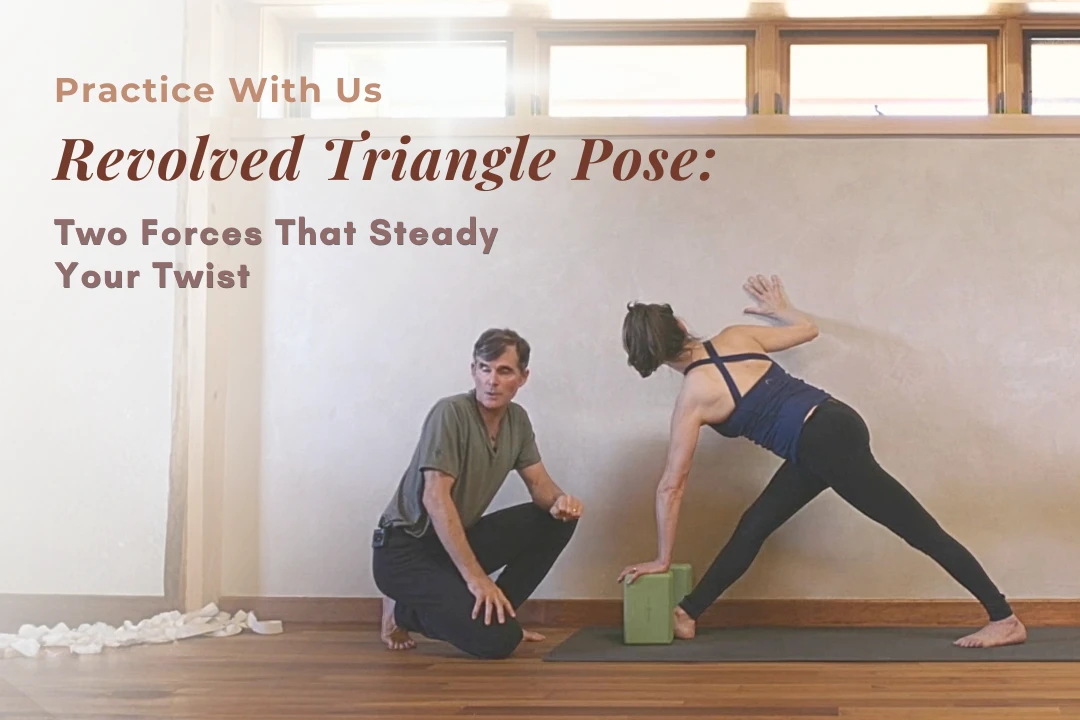
Revolved Triangle Pose (Parivrtta Trikonasana) can feel like a wobble waiting to happen. You are asked to keep your legs and hips steady while your spine rotates and your chest opens toward the ceiling. Naturally, the instinct is to muscle the twist and hope you stay upright. Yet the steadiness you are looking for does not come from force. It comes from two opposing actions that quietly hold you in place, and once you feel them, the whole pose settles.
The Two Forces That Steady Revolved Triangle Pose
Picture your back foot pressing firmly into its outer edge, rooting down and back. At the same time, your chest spirals open in the opposite direction, toward the ceiling. These two actions pull against each other, and that gentle opposition is exactly what creates stability. One anchors you; the other opens you. As a result, the twist feels supported rather than precarious. A block under your bottom hand adds to that steadiness, bringing the floor up so your spine can stay long. In other words, you are not balancing on willpower. You are balancing on a structure you have built.
How Tias Sequences Revolved Triangle Pose in This Practice
In this tutorial, Tias Little guides you through Parivrtta Trikonasana with the sequencing that makes it accessible. First, you will set your stance: front foot forward, back foot angled, hips squared toward the front of your mat as much as possible. Then he has you lengthen your spine before any rotation begins. Importantly, he keeps the twist in your thoracic spine, your mid-back, rather than torquing the lower back or letting the hips swing open. From there, you add rotation gradually, grounding the back foot while spiraling the chest. Along the way, he covers head position, strong active legs, and modifications for tight hamstrings.
Stability That Allows Mobility
Here is the principle worth keeping. Mobility does not arrive by chasing the twist harder. Rather, it emerges once your foundation is stable enough to allow it. So when you ground first and rotate second, your lower back stays protected and your mid-back is free to open. That order matters. Build the stability, and the rotation you are working toward appears on its own, safely and with room to grow.
Watch Tias Little guide you through the full tutorial below.
Ready to feel steady in your twist? Subscribe to our YouTube channel for more standing twist tutorials that build strength and rotation together.