A Life of Sacred Movement: A Conversation with Judith Hanson Lasater
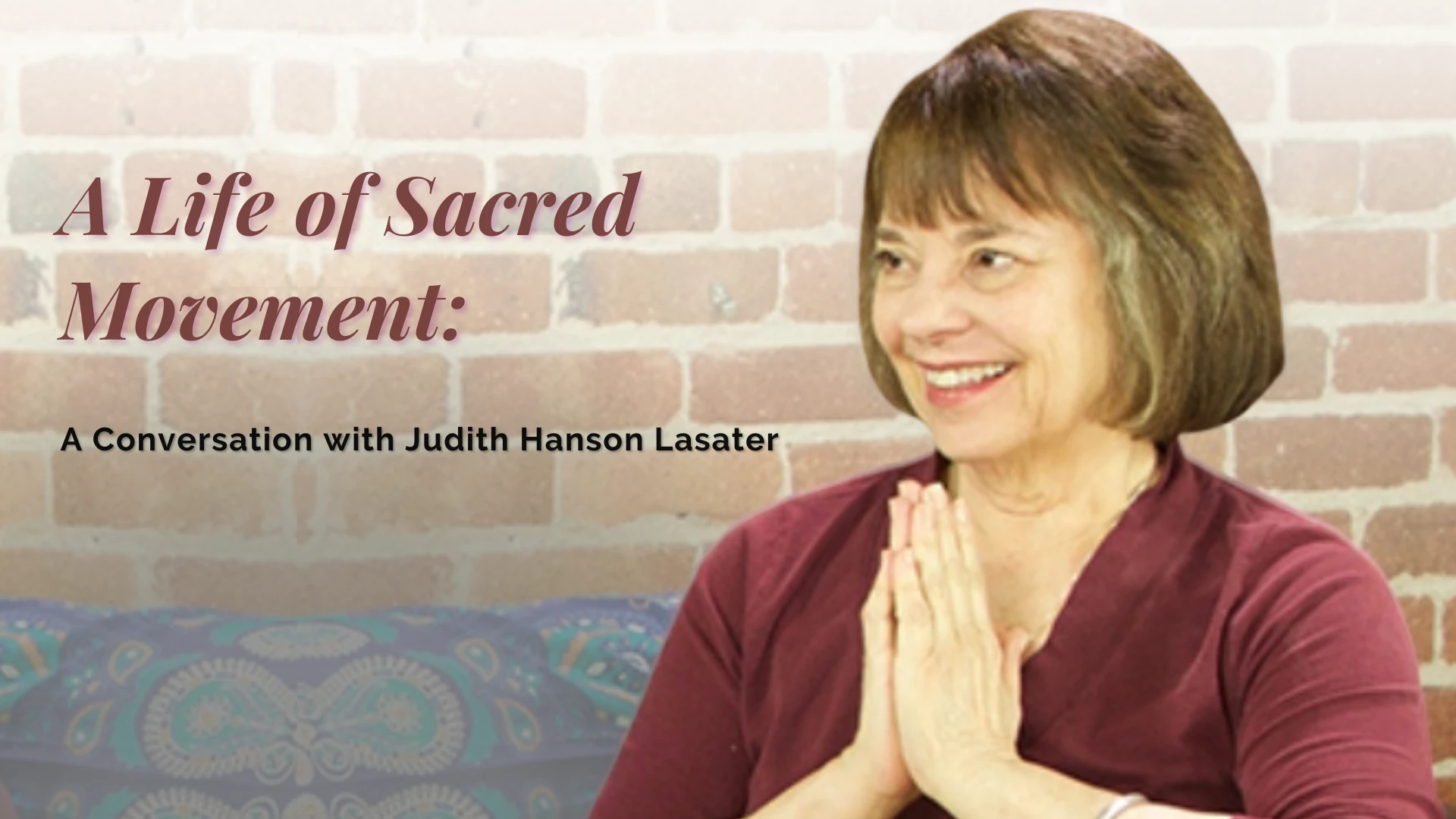
YogaUOnline sat down with renowned yoga teacher Judith Hanson Lasater — a 40+ year practitioner, physical therapist, and PhD in East-West Psychology — to talk about the deeper intention behind asana, the surprising origin story of restorative yoga, and why stillness may be one of the most radical things we can offer the world today.
On the Origins of Restorative Yoga
YogaUOnline: You're often called the “queen of restorative yoga.” How did that become such a big part of your teaching?
Judith Hanson Lasater: It has kind of a two-part answer. I studied so much with BKS Iyengar and was introduced to the use of props, which was a very radical idea in the United States in 1974. People really rebelled against it. “Why do you need these props?” People didn't even like using the wall for a prop.
Of course, Mr. Iyengar pointed out that you use the floor. He said the body is a prop for the soul.
You might enjoy hearing the story of the first restorative class I taught. I was teaching up on the plains of Canada — I think it was Alberta. It was late in the year, getting dark on a Sunday afternoon, and a big bank of black clouds came rolling in across the plains.
Suddenly there was lightning and thunder and the lights went out in the hall. There were a lot of people there and it was pretty hard to see, and I thought, “We're going to run into each other.”
So I just said, “Okay, take this bolster and just lie over it.” I thought it would be safer if people were lying down and still. I'd just been making these things up — “Lie this way. Put your feet there. Now put your head there.” Pose by pose, I just stumbled into teaching a restorative class. It all happened by accident.
YogaUOnline: How did that accidental class turn into your life's work?
Judith Hanson Lasater: My twin brother became ill and passed away — he ended up dying on our forty-fifth birthday. After that, it was really hard for me to want to do handstands.
For almost a year, all I did was restorative yoga, especially Supta Baddha Konasana, well supported, because that's all I could do. My friend and first publisher said, “Why don't you write a book about restorative yoga?” That was in 1993. He had passed in '92. So I did, and that was Relax and Renew, my first book on restorative yoga.
It seemed to somehow magically start to appear when people really needed it. And certainly in a post-9/11 world — I actually taught my first restorative teacher training two months before 9/11. And that was really exactly what we needed. We need to be still, quiet, dark, and warm.
It is calming to Vata Dosha. It is time. It is necessary. It is not a luxury. We must have introverted, quiet time, if at all possible in our lives, because I think our nervous system is so hyper-stimulated, over-caffeinated, and we don't sleep enough. All of these things can be very detrimental to our health.
On Why Restorative Yoga Isn't Just “Lying on the Couch”
YogaUOnline: To an outsider, restorative yoga can look like someone just lying on a bunch of bolsters for ten or fifteen minutes. What makes it so powerful?
Judith Hanson Lasater: I think it's what we started with — the intention. Let me tell you a little story. Years ago, in another state, I was somehow asked to go to a high school and teach a yoga class.
I got to Savasana, and I was trying to explain the idea of it to these teenagers. One young man raised his hand and said, “Oh, I get it. Your body sleeps and your mind watches.” I never forgot that. I felt that was a perfect explanation. It's a very concrete way to take people into a meditative state.
Many people do not have the ability to sit in a Half Lotus. Sitting meditation requires more than people realize, because the posture is everything. When you change your physical posture, you change your brain function — this is a scientific fact.
The ability to sit there for twenty minutes without moving is way past what most people can do. When you put someone in a restorative position, with props which support the body and create the feeling of ease — my definition of restorative yoga is the use of props to support the body in positions of comfort and ease, to facilitate health and relaxation. And it turns out that relaxation and health are the same thing.
On Forgiveness, Mortality, and “Eating the Strawberry”
YogaUOnline: You've spoken about self-forgiveness as part of this practice. Can you say more?
Judith Hanson Lasater: I think what we need to do is we need to deeply forgive ourselves. And this is not a wimpy kind of forgiveness. This is a deeply rooted, fierce willingness to let go of our guilt and our shame and our attachment to what we believe are our failures — to recognize how we may have hurt self or others, accept that responsibility, and then forgive ourselves.
Because when we do that, there's a softness and a delight in our practice that's not about force or punishment or aggression. And when we do forgive ourselves deeply, we can forgive others, because the world needs forgiveness.
YogaUOnline: You've also mentioned a favorite story about a strawberry. Can you share it?
Judith Hanson Lasater: There's a wonderful Buddhist story about a monk out walking in the forest. He looks around and sees a tiger slowly following him. He hurries and comes to a big cliff. He sees a thick root or vine growing there, and starts to climb down to escape the tiger.
But he looks down and sees another tiger at the bottom. To make matters worse, the vine is starting to tear. And he glances to the side, and there, growing on the side of the cliff, he sees the reddest, juiciest, most perfect strawberry he's ever seen. So what does he do? He reaches over, takes the strawberry, and eats it.
I translate that into a mantra: “eat the strawberry” — which means death is coming. We are mortal. There is no way to live a life without stress or difficulties or suffering. There's happy times, too. So what are we to do? This story tells us: eat the strawberries. This moment, you're still alive.
When we do restorative yoga, when we release the tension — which is the past — we let go of the past and sink deeply into the present. We are eating the strawberry, and the deliciousness of this wonderful, quiet moment with no ambition and no judgment. No one needs us. There's nothing to produce. We don't have to earn anything, prove anything, do anything.
And there is something so healing, both physically and spiritually and emotionally, about letting go deeply into your own self. You are your gift to the world.
On Attention, Presence, and the Question We Rarely Ask
YogaUOnline: You've spoken about a specific question you return to on the mat. What is it?
Judith Hanson Lasater: “What am I allowing to have my attention right now?” Is it my phone? Is it my computer? Is it my child? If you really work with that question in the day, you will see it's other people's tasks — it's never really yourself.
This is the twenty minutes when you give your full attention to yourself. You become aware, when you lie there, that you're uneven, or where you're holding tension — in your jaw, in your tongue, in your shoulder, in your gut. And you find a different state of harmony by watching and observing lovingly and simply being with yourself.
On What Makes Asana an Asana
YogaUOnline: Stepping back — what is it that makes a yoga pose more than just a physical exercise?
Judith Hanson Lasater: I have always had the sense that there is really no difference between the way I do Trikonasana or the way I exhale or the way I live — or how I want to become a friend to myself by observation and letting go of my attachments and noticing my thoughts.
I don't understand how people teach yoga without that, because that to me is what makes asana an asana. It's the intention with which we take it. It's the ritual of it. An asana is an archetypal, in the Indian sense, expression of our whole being.
If I learned anything in all these years of practice and teaching, it's that you simply cannot separate the body, the emotions, the mind, and the soul. That's what it means to be a human being — to be incarnated with this Atman that is part of the whole and yet to be living flesh.
All of who we are is what we bring to the mat. And the more we know that, and the less fear we have about that, and the more we accept that, the more integrated we have the potential to become.
YogaUOnline: Does that mean whatever habits we cultivate on the mat spill back into the rest of our lives?
Judith Hanson Lasater: Yes, I agree with you. It is a dance. The way we do asana is the way we do our life. Are we aggressive? Are we halfway doing it? Are we resenting it? Are we loving it? Are we using it as an escape? Are we using it to manipulate ourselves away and call that discipline?
It's a mirror. The practice is neutral. The poses are neutral. And what they do is show us who we are.
There's a wonderful story in the Vedas about a village that was having a drought. Some men came in with wagons and said, “Go get a container. We brought you water.” Some people showed up with a bucket and some people came with a barrel. That's the way it is with yoga practice.
Whatever container we bring to the mat, whatever hope we bring to the mat, whatever possibility we're seeking, we're going to find that, because everything is there. If you just want to get strong and flexible, that's there. If you wanted to cultivate a deeper practice, that's there.
The variable is not the practice. It's not the pose. It's not the breath. It's not the meditation technique. It's not the mat. The variable is you and me.
Closing Thoughts
YogaUOnline: Any final words for people just beginning — or returning to — this practice?
Judith Hanson Lasater: There's big debates, but let's just pick a round number — five thousand years old. It could be incorrect, could be much less than that, but just for fun. I've been practicing for forty-eight years.
Forty-eight years in one hand, five thousand years in another. I'm definitely a beginner. We're all beginners. Plus the fact that you don't know what you did in your last lifetime — maybe you were a yogi then.
So you start when it's right for you. Do something every day. Find your yoga and love it.
JOIN OUR SUMMER SPECIAL WITH JUDITH HANSON LASATER! RESTORATIVE YOGA AND MOVING BODY COMBO!

Also, read...
A Life of Sacred Movement: A Conversation with Judith Hanson Lasater
Do You Suffer from Tin Man Syndrome?
Yoga for Kids: Helping Children Suffering from Chronic Stomach Pain
Related courses
Join Our Age Strong Community – More Courses Coming Soon!
How Not to Be Present: Understanding the Power of Mind and Consciousness
Yoga for Flexibility: Fascia, Flow, and Metabolic Efficiency
Eva Norlyk Smith, Ph.D., C-IAYT, is the founder and President of YogaUOnline. She is a lead trainer in YogaUOnline’s Yoga Wellness Educator program, an RYT-300 Yoga Alliance-approved training that focuses on giving teachers the skills they need to offer wellness courses and work with older beginners.
Eva is a trained yoga therapist at the 1,000-hour level as well as a trained bodyworker at the 500-hour level. She is the co-author of several books, including Light Years Younger with Dr. David J. Goldberg.