The Molecular Switch That Builds Your Health Span — And What Flips It
The single energy switch in every cell that exercise flips, no prescription required
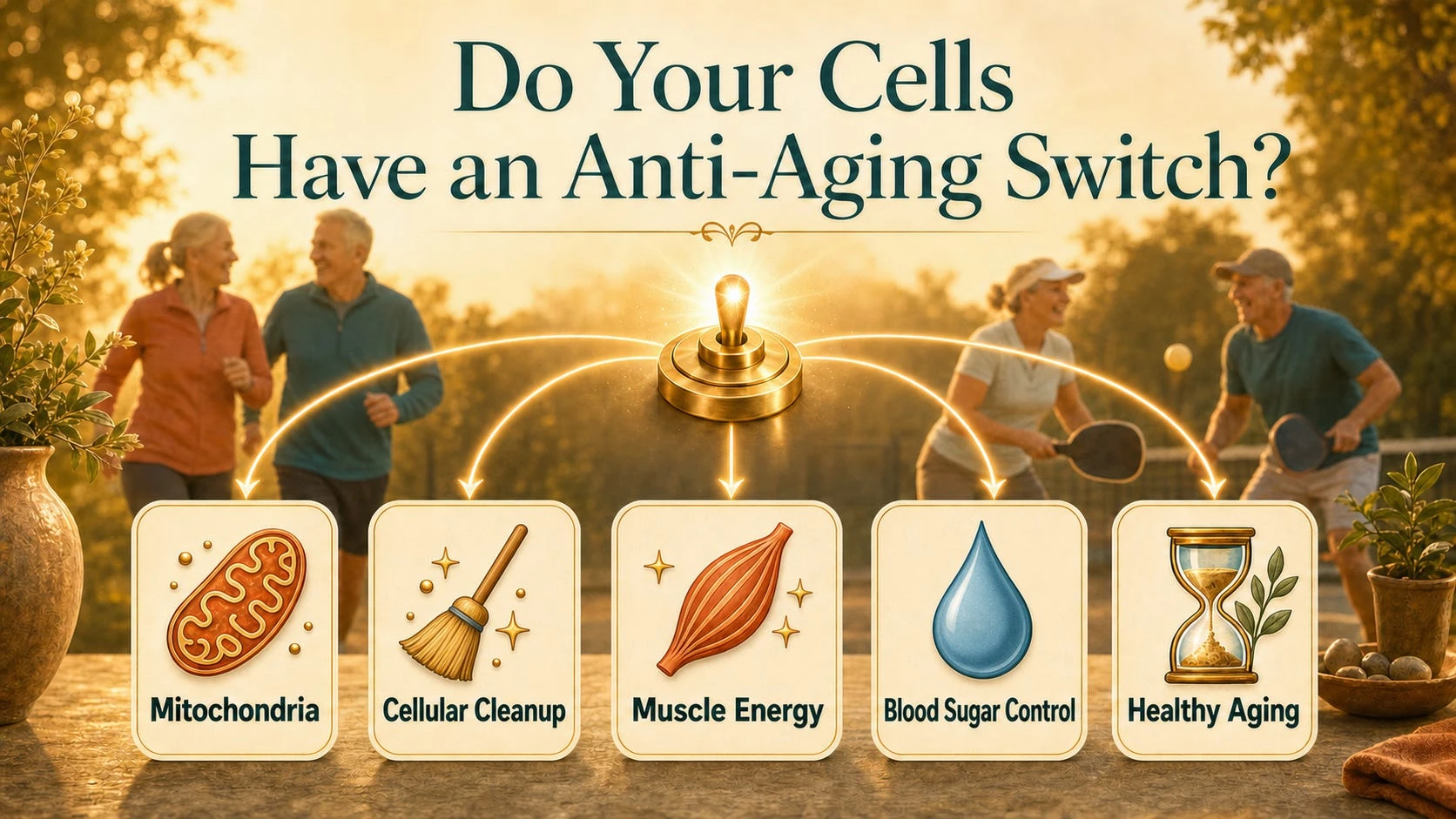
In a recent article, we discussed some of the little-known keys to building your health span. And of course, any article discussing health span must also talk about the vital importance of exercise.
But have you ever wondered why and how exercise has all these well-researched benefits?
On paper, exercise is such a plain-vanilla, simple act. You move your body, you sweat a little, you get tired.
That’s it. Not sexy like peptides. Doesn’t come with a prescription from your doctor.
And yet somehow exercise does EVERYTHING. . . .
Better heart health. Better blood sugar. Better mood. Stronger bones. Sharper brain. Lower cancer risk. Lower risk of chronic diseases, including Alzheimer’s and dementia. Faster recovery if you ever get seriously sick or hurt.
No pill does that. No supplement does that. Nothing else in medicine touches that many systems at once. . . .
So the real question is: how? How does one simple habit reach that far into the body?
Turns out, scientists have been chasing that answer for years. And in a study published on February 2026, a team at Virginia Tech got closer than anyone ever has.
Meet AMPK: Your Body’s Energy Switch
Every cell in your body has a built-in energy sensor called AMPK. Think of it as a thermostat for your cells. Its whole job is to notice when a cell’s energy tank (a molecule called ATP) starts running low.
The second AMPK senses “hey, we’re low,” it flips into emergency mode. It tells the cell: stop growing, stop wasting energy, start cleaning house, and start building new energy power plants (your cell’s mitochondria) so we have more energy next time.
That’s it. That’s the whole mechanism behind why exercise is so powerful.
When your muscles work hard, they burn through fuel fast, AMPK senses it, and it hits the panic button — in a good way.
Researchers have known this part for a while. What they didn’t know, until a few months ago, was which piece of AMPK actually controls your ability to exercise — and how far its reach really goes.
That’s what the Virginia Tech researchers spelled out, in remarkable molecular detail. And it turns out AMPK doesn’t just “help you get fit.”
It sits at the center of a chain reaction that reaches into your metabolism, your mitochondria, and — through pathways scientists are still mapping — how your whole body ages.
Not a supplement. Not a $500 injection some biohacker is selling you on Instagram.
A walk. A swim. A pickleball match.
It Comes Down to One Amino Acid: T172
The switch exercise flips to turn AMPK on is a single spot called T172 — and scientists have known about it for decades. What the Virginia Tech team at the Fralin Biomedical Research Institute did, using gene-editing tech, was pin down which version of AMPK’s T172 actually runs your muscles, and exactly what it does once exercise flips it.
To prove how important this one spot really is, they created mice that couldn’t activate AMPK at that exact location.
What happened? Those mice fatigued dramatically faster. They tired far sooner than normal mice, and their muscles were forced to fall back on burning through sugar for quick energy much earlier — a sign their normal energy machinery couldn’t keep up.
One switch. Disable it, and physical performance falls off a cliff.
And here’s the interesting part: this same tiny switch doesn’t just control your mitochondria (your cellular batteries).
It ALSO controls how your muscles contract and how they burn sugar for fuel. One spot. Three massive jobs.
That last one — the sugar-burning — was actually the researchers’ main focus. This same switch governs how your muscles pull sugar out of your bloodstream and burn it, which is exactly why the team sees it as a promising target for treating type 2 diabetes.
One honest caveat: the core experiments here were done in mice, not people. The switch works the same way in human muscle, and exercise’s broad benefits are well documented in humans — but the precise mechanism this study nailed down was demonstrated in mice first.
It’s like finally tracing every wire behind a light switch you’ve been flipping your whole life — and seeing exactly what it powers.
Why This Matters Way Beyond the Gym: Affecting the Hallmarks of Aging
Here’s where it gets bigger than “exercise is good for you.” Yeah, we all know that.
To be clear, this particular study was about one thing: how this switch runs your muscles. But AMPK is the same molecule in cells all over your body, and a much larger body of research — built up over years, across many labs — has tied it to the deeper biology of aging itself. Here’s the bigger picture that work points to.
Aging researchers have spent over a decade mapping out the specific things that break down in our bodies as we get older. They call them the Hallmarks of Aging, and there are twelve of them. Things like:
- Your cells’ batteries wearing out (mitochondrial dysfunction)
- “Zombie cells” that stop working but won’t die, and poison nearby tissue (cellular senescence)
- Your DNA slowly collecting damage over time
- Your body’s repair crew running out of steam (stem cell exhaustion)
For years, scientists studied these as separate problems. Different labs. Different research. Totally different conversations.
But it turns out they’re connected, layered on top of each other like dominoes. And AMPK sits right in the middle of that domino chain. One activation of AMPK from a single workout can simultaneously:
- Trigger new mitochondria to be built
- Clean out damaged cellular junk (called autophagy)
- Slow down the buildup of zombie cells
- Support DNA repair
- Wake up your body’s stem cells
That’s five or six major aging mechanisms, moved by one switch, from one workout.
This is a big part of the scientific story behind why active people seem to age differently. Not vaguely “healthier.” Differently, down at the level of their cells.
Is There a Peptide for That? The $500 Injection vs. a Free Walk
Not surprisingly, the biohackers who are into the injectable peptides craze are all over this. When it comes to AMPK activation, the focus is on a peptide called MOTS-c. The claim is that this peptide will activate this exact same AMPK switch without the workout. Not surprisingly, it is one of the hottest things in tech-bro longevity circles right now.
So, a $500 injection or a nice walk in the woods?
In our assessment, there's not really a choice. Mainly because substances that have primarily been tested on mice and in cell dishes warrant caution before human use
When it comes to peptide research, the list of solid research involving actual humans is disturbingly short.
Apart from the fact that peptides are not FDA-approved for this use, doctors have flagged a real concern: messing with a cell growth signals can, in theory, encourage the wrong kind of growth too, like tumors.
Nobody’s proven that the cancer risk doesn’t exist. And it makes sense to avoid becoming a human guinea pig until researchers find out more.
Especially since exercise flips the exact same switch, for free, and with zero side effects.
And, it comes with about fifty additional benefits a needle could never give you. Stronger bones. Better balance. A stronger heart. Greater brain health and better cognitive reserve. The actual physical capacity to recover if something ever goes wrong with your health.
The free, extensively studied, side-effect-free version is the clear choice.
Switching On Your Cellular Symphony: Two Keys When You Just Don’t Feel Like It
Two Keys for Overcoming Resistance and Learning to Listen to Your Body
Here’s the part nobody puts in the research paper: knowing all of this doesn’t automatically make you want to exercise.
You can understand exactly what T172 does, memorize every hallmark of aging, and still find yourself standing in your kitchen at 6pm thinking, “I just don’t have it in me today.”
That’s not a willpower problem. And it’s usually not really a time problem either — if you actually loved the movement you were about to do, you’d find the twenty minutes. What’s actually going on is something more physiological, and once you see it that way, it gets a lot easier to work with instead of against.
Key #1: Ask “What Can I Do?” Instead of “What Should I Do?”
When you’re depleted, your brain defaults to the version of exercise that requires the most energy you don’t have: the full workout, the whole routine, the intensity you “should” be hitting. No wonder you bail before you start.
Try asking a smaller, kinder question instead: not “what’s my workout today” but “what can I actually do right now.” Some days that’s five minutes of stretching. Some days it’s a slow walk to the mailbox and back. The point isn’t to lower your standards forever. It’s to give your body an on-ramp instead of a cliff edge.
This matters more than it sounds like, because of something we now understand at the cellular level. AMPK doesn’t flip on instantly at full blast. It responds to demand, gradually, as your muscles start working and your energy reserves start to dip. Give it a few minutes of easy movement, and you’ll often notice something real: the fatigue starts to lift, a bit of actual energy shows up, and the next five minutes suddenly feel more possible than the first five did.
That’s not you talking yourself into it. That’s your switch warming up.
Once you feel that shift, you’re free to add more, more speed, more resistance, more time. But the shift has to come first. You cannot think your way into that feeling. You have to move your way into it, slowly enough that your body can catch up to the invitation.
Key #2: Trade the “Should” for a Bottom-Up Relationship With Movement
The second key is less about technique and more about a whole different way of relating to exercise.
Most of us were raised on a top-down model: your head decides what your body should do, and your body is supposed to comply. Exercise becomes another item on the list of things you’re supposed to want, supposed to prioritize, supposed to feel guilty about skipping. That’s an exhausting way to relate to your own body, and it’s also, frankly, not very effective. Willpower is a limited resource. It runs out. “Should” runs out with it.
A bottom-up approach flips the direction. Instead of your head issuing orders, you let your body’s actual state lead. You check in first: How does my body feel right now? What is it actually asking for? Sometimes the honest answer is a hard workout. Sometimes it’s a slow walk outside. Sometimes it’s five minutes of just moving your shoulders and neck at your desk. All of those count. None of them are the “wrong” answer.
This isn’t about lowering the bar. It’s about noticing that when you stop forcing movement from the outside and start listening for it from the inside, something shifts. Exercise stops being a debt you owe your future self and starts becoming something closer to what it actually is: your body’s way of asking for the very switch this whole article has been about.
Over time, that shift in relationship tends to matter more than any specific plan. The people who stay consistent for years, the Super Agers among us, usually aren’t the ones with the most disciplined “should.”
They’re the ones who found their way to a “would like to,” even if it took a while, and even if it looks different from what they were originally told exercise was supposed to look like.
Your cells don’t care whether the movement that got them there came from a rigid plan or a slow walk you actually wanted to take. AMPK responds to demand, not to willpower. Meet your body where it is, let the energy build from there, and the switch does the rest.
The One Thing You Should Actually Take From This
You don’t need to understand amino acids or gene editing to use this. Here’s the entire takeaway:
Every single time you get your body moving hard enough to feel it, you are flipping a switch that scientists just spent years pinpointing to a single molecular location.
And that switch is reaching into your heart, your brain, your muscles, and the literal aging process happening inside your DNA, all at once.
That walk or workout you almost skipped today?
It wasn’t just “good for you” in some vague, throwaway way.
It was precision medicine. You just didn’t need a doctor with a prescription pad to access it.
What Comes Next: From the Why to the How
Understanding health span is the first step. Building it is the next — a subject explored further in the related articles below.
Join our new series on Building Your Health Span. Thru September 30, we have lowered the rate for annual subscribers – and, annual subscribers get our 3.5 workhop on Extending Your Health Span.

Also, read...
The Molecular Switch That Builds Your Health Span — And What Flips It
Building Your Health Span: Lessons from the Super Agers
Related courses
Join Our Age Strong Community – More Courses Coming Soon!
How Not to Be Present: Understanding the Power of Mind and Consciousness
Yoga for Flexibility: Fascia, Flow, and Metabolic Efficiency

Eva Norlyk Smith, Ph.D., C-IAYT, is the founder and President of YogaUOnline. She is a lead trainer in YogaUOnline’s Yoga Wellness Educator program, an RYT-300 Yoga Alliance-approved training that focuses on giving teachers the skills they need to offer wellness courses and work with older beginners.
Eva is a trained yoga therapist at the 1,000-hour level as well as a trained bodyworker at the 500-hour level. She is the co-author of several books, including Light Years Younger with Dr. David J. Goldberg.