Crossing the Great Aging Divide
Once you get on the other side of 65, there’s a thing that begins to jump out at you that you never noticed before: the Great Aging Divide.
You start noticing it everywhere. Two people, same age, same neighborhood, sometimes even the same family — and yet one is out gardening, traveling, playing sports, fully independent, while the other has become weak, housebound, and increasingly incapable of doing simple tasks like walking or getting up and down from the floor.
By our seventies and eighties, this divide becomes stark, and impossible to ignore once you start noticing it. I’ve watched it play out in real time in my own circle of friends: on one side, people who’ve been athletic most of their lives and remain remarkably active decades later; on the other, friends who were less active, or not active at all. Watching both groups age side by side, the contrast in serious disease, recovery from health crises, and even mortality has become impossible to explain away as coincidence.
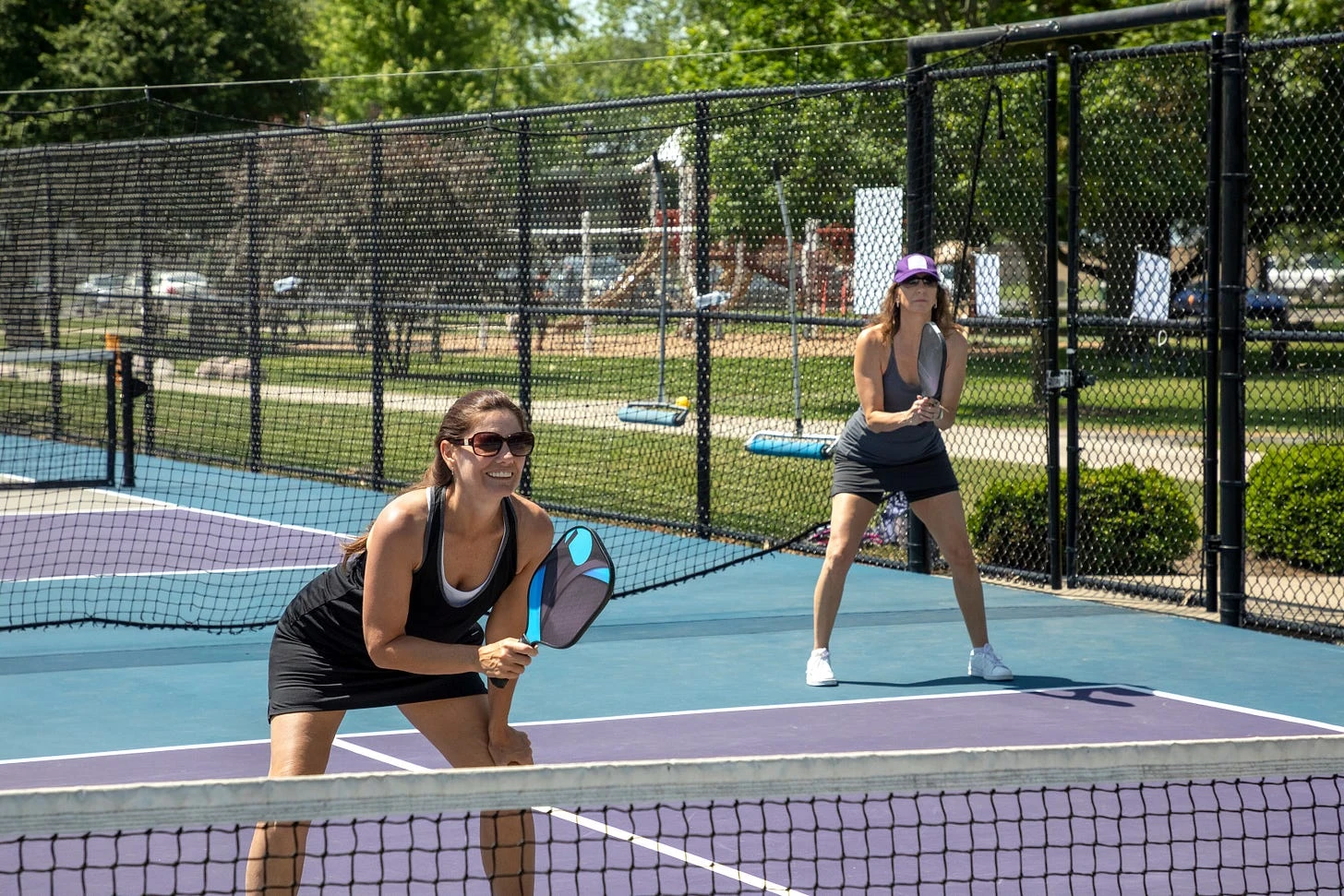
Nowhere has this divide been more visible to me than in my pickleball circle of Super Ager friends.
What the Pickleball Super Agers Taught Me
When I started playing in 2018, little did I know that the pickleball court would become something like an ongoing observational science experiment for me in the factors that shape our health span.
For almost eight years now, I’ve been playing with a group of very active pickleball players, who now are mostly over 70+ years-old — the Super Agers, as I like to call them.
(A quick note: “Super Ager” was originally coined by cognitive neuroscientists to describe older adults with exceptional memory. I use it more broadly here, since in my view, humans are whole beings, and cognitive and physical resilience are too intertwined to box separately.)
What I’ve learned watching these 70+ year-old Super Agers is that the vast majority of the most active players in that group are like beach balls in water. They can go down, but they bounce right back up.
Lucia, one of our most active players, had a serious health scare at age 68 — the kind with very poor odds of recovery that could have ended her active, independent lifestyle for good. She was back on the court within five months, beating the odds and playing her full game as if nothing had happened. James, aged 74, has navigated two heart attacks over the last year. Ben, at 79, had a stroke that impeded his speech — not his ability to move, write, or play, just his speech — for almost a year. He’s now back on the court at 80, fully agile with 95 percent of his speech regained. (All names have been changed.)
And yes, there’s also the usual assortment of age-related challenges in this group: hip replacements, shoulder injuries, the occasional wrist fracture after a fall. But the vast majority of those who’ve faced what would usually be considered serious health challenges have worked their way back to full or nearly full strength. Like the proverbial beach ball, they just come right back.
For a long time, I chalked this up to luck, good genetics, early intervention, or plain stubbornness — and to be sure, these things all play a part. But watching the contrast in rates of serious disease and mortality between this group and less active friends in my broader circle, it’s become clear that something else is going on.
One useful way to picture where any of us sit on the Great Aging Divide is a hierarchy running from elite athlete through fully fit, semi-fit, and independent, down through pre-frail, frail, and dependent — a spectrum first introduced by aging-researcher Waneen Spirduso and further developed by the Functional Aging Institute.

In practical terms, “semi-fit” might mean someone who can still manage stairs and groceries but tires easily, while “pre-frail” often means noticeable slowing, some muscle loss, and early difficulty with tasks like rising from a chair without using the arms.
The Science Behind What I Was Seeing: The Masters Athletes
It turns out my Super Ager pickleball group isn’t some unusual fluke. There’s a growing body of research around it.
In her classic aging-research text Physical Dimensions of Aging, Waneen Spirduso devotes an entire closing chapter to what she calls the “physically elite elderly” — older adults who keep training and competing well into their sixties, seventies, and eighties, often in World Masters Athletics tournaments, the Senior Olympics, and World Veterans Games. What the research on these Masters Athletes reveals is remarkable: athletes aged 70 and over set incredible world records in track, road running, swimming, and powerlifting that frequently rival the fitness of much younger adults. Even at age 80, the fastest Masters runners in the world can still complete a 10K — about 6 miles — in a little over 40 minutes, while the average untrained adult under 60 often can’t jog a mile without stopping.
Genetic inheritance and luck only explain part of the picture, Spirduso notes. The athletes she studied “maximized their potential by continuing to train physically and by maintaining good health habits” over a lifetime — precisely the pattern I see, week after week, in the Super Agers I share a pickleball court with.
Becoming a Super Ager: Where Health Span Comes In
So that begs the question: What makes some bodies able to absorb a great health crisis and come back strong, while other bodies of the same age never fully recover from the same kind of hit?
Scientists have a name for the answer: reserve capacity. It might be one of the most important, yet still overlooked, parts of our conversation about aging well and extending our health span.
The science of building health span touches on a vast range of research that casts light on what tends to undermine it, and what can help us not only build and extend it, but bounce back after the physical challenges we inevitably encounter as we get older.
What Reserve Capacity Really Means
Think of your body’s reserve capacity as a kind of savings account. Every organ and system you have — your heart, your lungs, your muscles — doesn’t run at full power during a normal day. It runs at a fraction of what it’s actually capable of, keeping the rest tucked away for the day you really need it.
Most of us start our lives with a great endowment of reserve capacity. Young bodies, in particular, can call on far more capacity than they use on a typical day, ramping up to many times their resting output when the need arises — an enormous savings account most of us never think about.
The problem is that this savings account doesn’t stay full forever. It naturally shrinks with age, a process doctors call homeostenosis — basically, the slow undermining of our resilience, our ability to bounce back.
This is exactly why a healthy-looking older adult can seem perfectly fine one day, and then a small cold or a minor fall suddenly turns into a real crisis. It’s not that the illness or the fall was so much worse. It’s that there was less savings left in the account to draw from, and as this resilience dwindles, recovery begins to become incomplete.
Frailty and Resilience: Two Ends of the Same Continuum
Two people can suffer the exact same hip fracture, with the exact same bone scan results, and end up in completely different places six months later. One is walking again. The other never fully recovers.
The difference usually isn’t the fracture — it’s how much reserve each person had left in the tank before it happened, and how much wear and tear had already quietly built up in their tissues over the years.
This is the opposite end of the reserve capacity continuum: frailty. Frailty is what happens when reserve capacity runs low across many systems at once — the body simply doesn’t have much left to draw on when something goes wrong.
Researchers describe it as a syndrome that results from a decline in reserve capacity across multiple body systems, to the extent that early symptoms of failure begin to appear.
As a consequence, the frail person becomes more vulnerable to external stressors, like fracturing a limb after a fall, less likely to bounce back, and more likely to have a worse outcome in the face of challenges.
Frailty isn’t just a vague word for “getting old and weak.” In osteoporosis research, for example, it’s one of the strongest known predictors of both whether someone breaks a bone, and importantly, how well they heal afterward.
What’s Actually Draining the Account? A Look Inside Your Cells
So what’s actually causing that slow erosion of reserve capacity, at the deepest level?
A landmark 2026 study in Nature Aging offers a striking answer: comparing lifelong trained older adults to sedentary and even “normally active” peers, researchers found that more than half of the usual age-related decline in the genes that drive energy metabolism simply wasn’t present in the trained group.
Their muscles looked and functioned, molecularly, like they belonged to someone decades younger.
The mechanism behind this traces back to your mitochondria, the tiny engines inside every cell that turn food and oxygen into usable energy.
As we age, these engines wear out faster than the body can clear and replace them, leaving muscle fibers cluttered with damaged, underpowered machinery — the textbook explanation for why aging muscles lose power. What the Nature study showed for the first time is that this isn’t a fixed, one-way slide dictated by chronological age.
The most important takeaway from this study for anyone building a health span strategy was this: being generally active wasn’t enough. The “normally active” older adults in the study still showed the classic age-related decline in these genes.
What created the difference was structured, sustained training over years — precisely the kind of consistent challenge the players in my Super Ager group have been giving their bodies on the pickleball court. This is real-world confirmation that the cellular wear-and-tear described above isn’t a fixed, one-way slide dictated by chronological age. It’s can be altered, if we learn how to do the right things.
So How Do We Build Our Reserve Capacity?
The main takeaway? Like most physical functions, reserve capacity isn’t something locked in place by our genes or age. It responds to what you do, starting today, no matter how old you are.
When I first started pickleball in 2018, at age 63, I felt like an imposter. And in many ways, I was. With decades of yoga practice, I was in decent shape, but I had no sports experience, no tennis, no racquetball, no table tennis – unlike most of the other players, who’d been at this for decades.
My husband and I both started from nothing that year, and after six months of “sort of playing pickleball,” we went to our first pickleball camp — in Mexico, of all places.
To give you a sense of just how bad it was, we couldn’t even do a basic friendly volley drill. The camp leader, who knew ahead of time that we were beginners, politely made some obscure comments about how he’d thought we were “a bit further ahead,” and did a valiant job finding other players who would deign to play with us.
At the end of the seven-day camp, we were given awards matching our accomplishments. My award? “Most Improved Player.”
Yes. I know.
But as anyone who’s gotten smitten with the pickleball addiction that’s swept up this country knows, no matter where you start, you just do what you can. You drill, you take lessons, you find people kind enough to play with you. And slowly, you get better. And better. Eventually, people don’t look the other way when they see you.
Along the way, you discover the tribe. The Super Agers, Masters Athletes, call them what you want, they all have their own tribe — a group of fun, accomplished, smart, educated people who are simply fun to hang out with.
So where am I going with this? I’m not saying we should all start pickleball, or any other sport, to build our health span. The point is that physical activity and exercise are, hands down, the most effective way to transform your health, all the way down to the cellular level, as the recent Nature study shows.
The Illness-Wellness Continuum: Why Every Small Step Counts
There’s a simple way to picture where health span fits into the bigger conversation about aging, from a 1970s model by Dr. John Travis called the Illness-Wellness Continuum.
Picture a horizontal line with a neutral midpoint — no discernible illness or wellness, just baseline nothing. To the left, the line runs through disability and symptoms toward premature death. To the right, it runs through awareness, education, and growth toward high-level wellness.

Most of us only think about the left side: we wait until something hurts or shows up on a test, then treat it.
That’s necessary, but reactive — it can bring you back to neutral, but it was never built to take you further right. The wellness paradigm is the half most of us never learned to pay attention to: not the absence of illness, but how far right you actively choose to move.
This is really what health span, reserve capacity, and everything else in this piece has been pointing toward — not a single dramatic transformation, but the direction you’re moving in, day by day.
And the most encouraging part is that it really doesn’t take that much to move the needle. There’s lots of research to show that as little as a 10-minute walk will move us measurably in the right direction — a small effect that compounds over time.
The Super Agers in my pickleball group didn’t start on the far right side either. They started by choosing, repeatedly, to keep moving that way. So can you.
Your best bet is to find something you love so much that you’d rather do it than anything else. That’s how you slowly build your activity to a level where you gradually expand your reserve capacity, and with that, your health span.
So where does all this leave me now, eight years later? Well, I have dodged the mandatory injuries and slowly built my strength and ability to be a decent enough player to play every day of the week. And no, I am not a Masters Athlete, nor will I ever be.
But of course, that is not what matters. I didn’t set out to do all of this to change my health span, but the signs are there that it’s having an effect. My biological age clocks in at around 55, sixteen years younger. I can rough and tumble with our grandkids as much as I feel like (although I definitely can’t keep up with them).
But above all, mainly I just feel good — and that is the whole point, yes?
Watching my own pickleball group of Super Agers, it’s the same story. None of them built their reserve through one big, dramatic effort. They built it slowly, over years, through small, steady challenges, doing something they loved.
That simple, steady habit appears to be exactly what let a stroke survivor find his voice again, let two heart attack survivors return to the game they love, and let Lucia walk back onto the court and play like she never left.
That, in the end, is the real invitation buried inside all this science. You don't need to become a Masters Athlete, join a pickleball tribe, or chase any particular reps per strength-training session to start moving the needle. You just need to tap into that most powerful way of all to slowly transform your body and build your health span: Movement.
All it takes is choosing, every day, to add something to that reserve capacity savings account — a walk, a stretch, a flight of stairs instead of the elevator — and trust that your body is quietly listening, and rebuilding, every single time you do.
The Great Aging Divide isn't decided by one dramatic moment. Our health span is slowly carved over time by thousands of small, unremarkable actions. The good news is that you get to keep making them, starting right now.
What Comes Next: From the Why to the How
Understanding reserve capacity is the first step. The next is learning how to build it — the focus of the discussion below and in related articles on this site.
Join our new series on Building Your Health Span. Thru September 30, we have lowered the rate for annual subscribers – and, annual subscribers get our 3.5 workhop on Extending Your Health Span.