The Year I Joined the SuperAgers (Well, Sort Of ..)
What a group of 70-year-old pickleball fanatics taught me about the secret to moving like you're decades younger
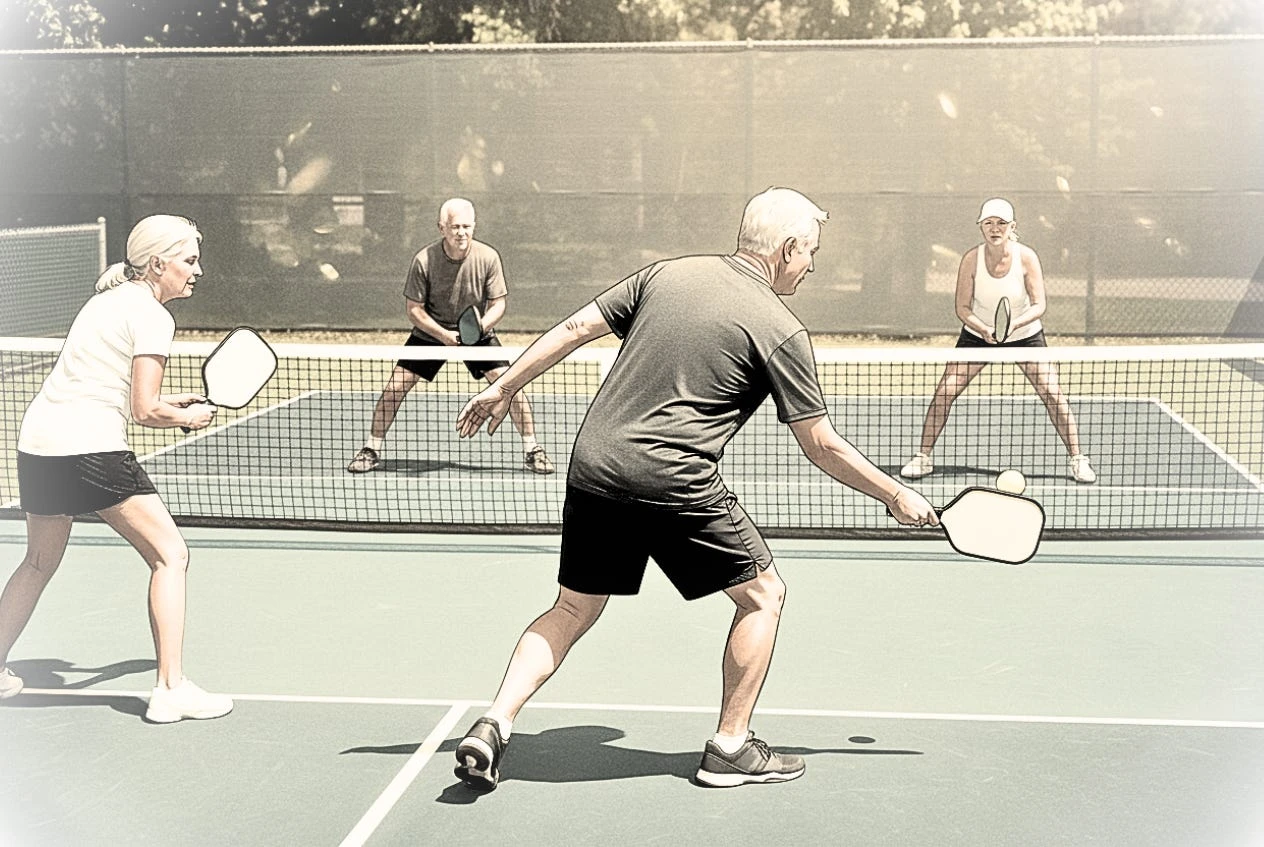
The year was 2018, and there were some new cool kids in town.
The picklers.
It was an exclusive, athletic club of SuperAgers aged 60 to 80, who were running around playing and having fun like 10-year-olds.
And I wanted in.
Badly.
It wasn’t just the pickleball.
It was the fact that these were people well on the other side of 50 who were still as fit and youthful as people decades younger. Whatever it was they were on, I wanted it too.
Have You Ever Noticed Just How Differently People Age?
Once you hit your mid-sixties, it becomes impossible to ignore.
Some people your age are still hiking, playing tennis, dancing, and traveling the world. They move easily. They look alive. They seem genuinely happy in their bodies.
Others — same age, sometimes even younger — are already talking about hip replacements. They’re stiff in the mornings. Stairs have become a project. They’ve stopped doing the things they used to love, one by one, because something always hurts.
What makes the difference?
That question has fascinated me for years. And the answer turns out to be both simpler — and more interesting — than most people expect.
The Functional Aging Institute has mapped aging into eight stages based on what your body can actually do day to day:
- Elite Athletes (what I call SuperAgers)
- Fully Fit
- Semi-Fit
- Higher Independent
- Lower Independent
- Pre-Frail
- Frail
- Dependent
Where you land on that ladder is not just luck. It’s not just genetics. To a very large extent, it comes down to choices — and knowledge. Specifically, knowing what to protect and how to protect it.
Back then, I knew exactly where I wanted to land. And I knew it wasn’t going to happen by accident.
It wasn’t easy — I have always been a klutz, and my chances of making it into that top group of elite athletes were slim.
But fake it till you make it, right?
And here’s the thing — my yoga background turned out to be my secret weapon. It helped me stay one step ahead of the one problem that trips up most active people over 50:
Boomeritis.
That’s the playful but very real term for all the joint and soft tissue injuries that baby boomers experience as they try to stay active and fit. Sore knees, tight hips, aching shoulders, pulled hamstrings. Sound familiar? Exercise injuries in the 45–64 age group jumped 56% over just seven years.
What I quickly figured out was that staying in the game wasn’t just about showing up. It was about learning how to take care of the body so it keeps saying yes for decades to come.
In other words, it was about movement longevity.
4 Things That Keep Your Body Young That Almost Nobody Talks About
Most of us know the basics: eat well, get some cardio, keep your weight in check. Good advice. But it turns out there are four other things — quieter, less obvious things — that are just as important to how well your body ages.
Most people don’t discover them until something starts going wrong.
Let me walk you through them.
1. Flexibility — It’s About a Lot More Than Touching Your Toes
Have you ever watched someone in their seventies move with total ease — bending, reaching, getting up off the floor without a second thought — and wondered how on earth they do that?
Flexibility. That’s how.
Not the gymnast kind. Not the “fold yourself in half at yoga class” kind. The everyday kind — the kind that lets your body move freely through its full range without pain, resistance, or that creaking, grinding feeling that tells you something has gotten stuck.
And new research shows that this matters — a lot — for how long you live.
In a major study tracking more than 3,000 people between the ages of 46 and 65 for nearly 13 years, researchers measured flexibility across seven joints and then followed up to see what happened. The results were remarkable. People with low flexibility scores were nearly twice as likely to have died during the study period. For women, the risk was even higher — nearly five times greater.
Harvard Health summed it up simply: greater flexibility is linked with longer lives.
But here’s the part that stopped me in my tracks — and that I think about every single time I step on my mat.
Your flexibility isn’t just about your body. It’s about your brain.
Researchers at King’s College London followed 324 pairs of identical twins for 10 years — which is a brilliant research design, because twins share the same DNA and grew up in the same family, so you can rule out genetics and early life as the reason. What they found was remarkable: the twins who had greater physical fitness and lower-body mobility in midlife had significantly better brain function a decade later. More gray matter. Better memory. Less cognitive decline. The effect was so strong that a meaningful difference in leg power translated to the equivalent of being 3.3 years younger cognitively — despite sharing identical genes.
Let that sink in. How well your body moves today may literally be shaping your brain tomorrow.
Flexibility also turns out to be a window into something deeper — a signal of how well all the systems of your body are communicating and working together. Which brings us to number two.
2. Movement — Not Just Exercise. All-Day Movement.
Here’s something that might surprise you: going to the gym three times a week is not enough.
Not because the gym isn’t great — it is! But biomechanist Katy Bowman, author of Move Your DNA, has spent her career showing us that exercise and movement are two very different things.
“Every single thing our bodies do requires movement — initiated by our musculoskeletal system — to be performed with ease. Digestion, immunity, reproduction — all of it.”
— Katy Bowman
Have you ever thought about the fact that your lymphatic system — your body’s built-in waste-removal system — has no pump of its own? It moves entirely through the mechanical pressure created by your muscles and tissues as you go about your day. Your digestion relies on movement. Your circulation depends on it. Even your immune system needs you to move to work properly.
Bowman calls it “movement nutrition” — and the idea is exactly what it sounds like. Just as your body needs a wide variety of foods to thrive, it needs a wide variety of movements. Not just cardio. Not just strength training. But full-body, multi-directional, all-day movement that reaches into every nook and cranny.
“Watch your habits, for they become your posture. Watch your posture, for it creates your boundaries. Watch your boundaries, for they restrict your growth. Watch your restrictions, for they create immobility. Watch your immobility, for it becomes your illness.”
— Katy Bowman
When movement stops — or becomes too narrow and repetitive — the body starts to suffer in ways that go far beyond tight muscles. Fluids stagnate. Tissues dry out. Systems slow down. And that is a gateway to a kind of aging that sneaks up on you.
3. Fascia — The Hidden Player That Controls It All
Most of us know about muscles, tendons, and joints. But there’s a fourth player in this game that almost nobody talks about — even though it may be the most important one of all.
It’s called fascia. And it’s about to become your new best friend.
Have you ever wondered why, after a long week at a desk or a stressful stretch of days, your whole body just feels… locked? Not one specific muscle — everything. Like you’re moving through wet concrete?
That’s your fascia talking.
Imagine a full-body wetsuit made of living tissue — a continuous, three-dimensional web that wraps around every single muscle, organ, bone, and nerve in your body. From the top of your head to the tips of your toes, it’s all connected. That’s fascia.
For a long time, scientists thought fascia was just boring packing material — the stuff they pushed aside to get to the “real” anatomy. They were very wrong.
“When we get stiffer as we age, it is primarily not because our muscles shorten. It is the body-wide fascial connective tissue network.”
— Dr. Robert Schleip, Director of the Fascia Research Project, Ulm University
Here’s the part that blew my mind when I first learned it:
You don’t lose flexibility because your muscles get tight. You lose it because your fascia dries out and gets sticky.
Inside your fascia lives a gel-like substance that works like the body’s own natural lubricant — keeping layers of tissue sliding smoothly, like well-oiled parts of a machine. When everything is working well, you feel light and fluid. You bend down to tie your shoes without thinking twice.
But when this lubricant dries out — from too much sitting, too little movement, or even from chronic stress — those layers start to stick together. Movement gets harder. Stiffness sets in. And that feeling of being “locked up” that so many people chalk up to “just getting older”? That’s your fascia calling for help.
Fascial stiffness can happen fast, too. Research shows that chronic stress alone can cause your fascia to tighten within just 48 hours. That’s not years of wear and tear — that’s the aftermath of a rough week.
The good news? Fascia responds quickly to the right kind of movement. Give it what it needs, and it bounces back.
4. Balance and Body Awareness — Your Body’s Navigation System
Here’s the fourth one that most people never think about until they slip on a wet floor — and suddenly realize their reflexes aren’t quite what they used to be.
Have you noticed how some people seem to catch themselves when they trip, while others go straight down? That split-second ability to right yourself is called proprioception — your body’s sense of where it is in space. And it begins to quietly fade in most people after age 50.
Each year, more than one in four adults over 65 takes a fall. Falls are the leading cause of injury-related death in older adults. And yet balance training is almost never part of people’s routines — until something goes wrong.
Here’s the beautiful part: fascia and balance are deeply connected. The fascial network contains more sensory nerve endings than any other tissue in the body — around 250 million of them — constantly sending your brain information about where your body is and what adjustments to make. When fascia becomes stiff and dried out, that communication system gets fuzzy. Balance suffers. The risk of falls goes up.
Yoga, with its single-leg poses, flowing transitions, and constant invitation to feel what’s happening in your body, trains proprioception in ways that most exercise programs never touch.
The Frailty Trap: Why This All Matters More Than You Might Think
So what happens if we let all four of these things slide — little by little, year by year?
That’s where frailty comes in. And before you picture a frail elderly person in a hospital bed — that’s not what we’re talking about here. Frailty is a clinical syndrome, a recognized pattern of decline with specific warning signs. And it can start much earlier than most people realize.
Researchers have identified five red flags:
- Unexplained weight loss
- Constant tiredness or low energy
- Weak grip strength
- Slow walking speed
- Very little physical activity
Three or more of those? That’s frailty. One or two? That’s pre-frailty — already on the slope.
Around 17% of older adults are already frail, and nearly half are pre-frail. And here’s the number that really gets my attention: studies following tens of thousands of older adults have found that those classified as frail face nearly three times the mortality risk of those who are not.
But here’s the part that matters most:
Frailty doesn’t arrive overnight. It sneaks up through mobility loss.
It works like a slow, quiet spiral. When moving becomes harder, you naturally start doing less. When you do less, your muscles get weaker. When your muscles get weaker, you feel more tired. When you feel more tired, you move even less. And little by little — without any single dramatic turning point — you slide down that aging ladder.
Fascia is right at the heart of this spiral. When fascial layers stop sliding, joints lose range of motion. Muscles can’t fire the way they should. Balance suffers. Movement becomes uncomfortable, so people avoid it. The fascia stiffens further. The spiral deepens.
Breaking that cycle — ideally before it even starts — is the whole game.
As Katy Bowman says: “Watch your immobility, for it becomes your illness.”
The Good News: This Is So Fixable
Here’s what I love most about everything I’ve learned on this journey:
None of this is inevitable.
Your fascia is not locked into a one-way road toward stiffness. Your body is not a machine that just wears out over time. It is a living, adaptable system — and it responds, beautifully, to what you give it.
Give it three-dimensional movement? It gets more fluid.
Give it rest and deep breathing? It softens and rehydrates.
Give it the gentle, spiraling, full-body work of yoga? It stays supple — even as the years go by.
Yoga turns out to be almost perfectly designed to address all four of the things we’ve talked about: flexibility, varied movement, fascial hydration, and balance. Dr. Schleip describes the ideal fascial workout as moving “like a cat or a tiger waking up in the morning — not in linear movements, but in three-dimensional twisting.” Sound familiar? That’s yoga, almost exactly.
And Anatomy Trains author Tom Myers, one of the world’s most respected voices on fascia and movement, reminds us that the body’s fascial fabric either supports us or limits us — depending on how we care for it. Yoga is one of the best tools we have for keeping that fabric supple, strong, and alive.
A large review of 33 studies found that yoga significantly improved walking speed and the ability to rise from a chair in adults over 65 — two of the key markers used to track frailty. Harvard researchers called the evidence “strong.”
I think about those pickleball players every time I step on the mat. They didn’t have a magic gene. They didn’t find a secret formula. They just kept moving — in the right ways, with enough variety and intelligence to keep all four of these systems healthy and humming.
That is movement longevity. That is what we’re going for.
And the beautiful thing is — it is never, ever too late to start.
How Do You Stack Up?
A Personal Check-In on Your Movement Longevity
This self-assessment is for paid subscribers of Eva Norlyk Smith
Most of us have a general sense of whether we’re “doing okay” physically. But vague feelings of “pretty good for my age” can mask slow, quiet declines that are much easier to address early than later.
This check-in is designed to give you an honest, compassionate look at where you stand across the four pillars we discussed in the article — flexibility, movement nutrition, fascia, and balance. It’s not a medical test. It’s a conversation starter between you and your body.
Take 5 minutes. Answer honestly. Then read your results.
Part 1: Flexibility
Score each question: 2 = Yes, easily | 1 = Sort of / with some difficulty | 0 = No / not really
1. Can you bend forward and touch your shins (or lower) without bending your knees?
2. Can you reach both arms overhead, fully extended, without your lower back arching or your shoulders hunching?
3. Can you sit comfortably cross-legged on the floor for at least 5 minutes?
4. Can you turn your head to look fully over each shoulder without discomfort?
5. Can you get up from the floor to standing without using your hands?
Part 1 Score: ___ / 10
Part 2: Movement Nutrition
Score each question: 2 = Most days | 1 = Sometimes | 0 = Rarely or never
6. Do you spend time moving in ways other than your regular workout — walking to errands, gardening, taking stairs, carrying things?
7. Do you spend any time sitting or moving on the floor rather than always in a chair or on a sofa?
8. Do you move in multiple directions during your day — not just forward — reaching sideways, twisting, bending in different ways?
9. Do you walk for at least 20–30 minutes most days, ideally on varied surfaces?
10. Do you take regular breaks from sitting — at least once every 45–60 minutes — to move around?
Part 2 Score: ___ / 10
Part 3: Fascial Health
Score each question: 2 = Yes | 1 = Somewhat | 0 = No
11. Do you wake up in the morning feeling relatively fluid and mobile (as opposed to stiff and needing a long time to “warm up”)?
12. After a period of sitting or rest, does your body recover its ease of movement quickly — within a few minutes?
13. Do you include any slow, sustained stretching or yin-style holds in your movement practice (held for 2 minutes or more)?
14. Would you say your stress levels are generally manageable — not chronically elevated for days or weeks at a time?
15. Do you drink enough water throughout the day to keep your tissues hydrated (pale yellow urine is a good sign)?
Part 3 Score: ___ / 10
Part 4: Balance and Body Awareness
Score each question: 2 = Yes, confidently | 1 = With some wobbling or uncertainty | 0 = No / I avoid this
16. Can you stand on one foot for at least 10 seconds without holding onto anything?
17. Do you feel confident walking on uneven surfaces — cobblestones, grass, gravel — without fear of tripping?
18. Can you walk in a straight line, heel to toe, for 10 steps without losing balance?
19. Do you feel aware of what your body is doing as you move — not just going through the motions, but actually sensing your body in space?
20. Have you had no falls or near-falls in the past 12 months?
Part 4 Score: ___ / 10
Your Total Score: ___ / 40
What Your Score Means
34–40: You’re in Great Shape — Keep It Up
Your body is responding well across all four pillars. The goal now is maintenance and refinement — not fixing problems, but deepening the quality of your movement and making sure you stay here as the years go by.
Your focus: Keep all four pillars active. Add variety and challenge to prevent plateaus. Consider exploring fascia-specific practices like Anatomy Trains-informed yoga or yin yoga to deepen the quality of your flexibility. The research suggests you are likely in the “Fully Fit” or above range on the functional aging ladder — protect it.
25–33: You're Doing Well, With Some Clear Opportunities
You have a solid foundation, but one or two pillars are asking for more attention. This is the sweet spot for meaningful change — your body is still highly responsive, and targeted work now pays off quickly.
Your focus: Look at which section had the lowest score and start there. If it was flexibility or fascia, a regular yoga practice — even 20 minutes three times a week — can produce noticeable change within 4–6 weeks. If it was movement nutrition, try Katy Bowman’s checklist (see the companion article) for one week and notice what’s missing from your movement diet. If it was balance, add a simple single-leg practice every day.
15–24: Your Body Is Sending You Signals — And This Is the Right Time to Listen
Scores in this range suggest that one or more of the pillars have been quietly declining — possibly for a while. This is pre-frailty territory. Not an emergency, but a clear invitation.
The good news: the body is remarkably responsive at this stage. People in this range often see significant improvements within just 6–8 weeks of targeted, consistent practice. The key is starting now, before the spiral deepens.
Your focus: Don’t try to fix everything at once. Pick the one pillar where you scored lowest and commit to one small daily practice for 30 days. Even 10 minutes of gentle, multi-directional movement each morning makes a measurable difference to fascial hydration and proprioception. A yoga-based movement program — especially one that includes fascial fitness principles — is one of the most effective starting points at this stage.
Below 15: Your Body Really Needs Your Attention
A score below 15 suggests that multiple systems are under-supported, and the risk of sliding further down the functional aging ladder is real. This is not a judgment — it’s information. And information is power.
Your focus: Please talk to your doctor or a physical therapist before starting a new exercise program. But also know this: even gentle, consistent movement — starting with just 5–10 minutes a day — has been shown in multiple studies to reverse frailty markers over time. You are not stuck. The body responds to care at every age. A supported, beginner-friendly yoga program is an excellent starting point.
One More Thing: Which Pillar Needs the Most Love?
Even if your overall score is good, look at your individual section scores. A score of 4 or below in any single section is worth paying attention to, regardless of your total.
Section Score | What It Suggests
8–10 | This pillar is strong — maintain and deepen
5–7 | This pillar needs regular attention
3–4 | This pillar is a priority — focus here first
0–2 | This pillar is significantly under-supported
Also, read...
The Year I Joined the SuperAgers (Well, Sort Of ..)
Do You Suffer from Tin Man Syndrome?
330 Billion Cells a Day: Your Body’s Internal Renewal Process and What Trips It Up
Related courses
Join Our Age Strong Community – More Courses Coming Soon!
How Not to Be Present: Understanding the Power of Mind and Consciousness
Yoga for Flexibility: Fascia, Flow, and Metabolic Efficiency

Eva Norlyk Smith, Ph.D., C-IAYT, is the founder and President of YogaUOnline. She is a lead trainer in YogaUOnline’s Yoga Wellness Educator program, an RYT-300 Yoga Alliance-approved training that focuses on giving teachers the skills they need to offer wellness courses and work with older beginners.
Eva is a trained yoga therapist at the 1,000-hour level as well as a trained bodyworker at the 500-hour level. She is the co-author of several books, including Light Years Younger with Dr. David J. Goldberg.
- Araujo, C.G. et al. (2024). “Can flexibility help people live longer?” Scandinavian Journal of Medicine and Science in Sports. Reported by EurekAlert and Harvard Health Publishing, 2024. Flexibility scores across 7 joints tracked in 3,139 adults aged 46-65 for 13 years; low flexibility associated with nearly 2x mortality risk in men and nearly 5x in women.
- Steves, C.J. et al. (2016). “Kicking Back Cognitive Ageing: Leg Power Predicts Cognitive Ageing after Ten Years in Older Female Twins.” Gerontology, 62(2), 138-149. King’s College London. 324 pairs of identical female twins followed 10 years; greater leg power and physical mobility predicted better cognitive function, equivalent to 3.3 years younger cognitively.
- Schleip, R. (2023). Interview transcripts: “The Fascia Connection: Keys to Enhancing Flexibility and Mobility” and “The Importance of Flow.” YogaUOnline webinar series. Fascia as primary determinant of age-related stiffness; hyaluronic acid densification; 48-hour stress-fascia link.
- Bowman, K. (2014). Move Your DNA: Restore Your Health Through Natural Movement. Propriometrics Press. Movement nutrition framework; all-day movement as distinct from exercise; whole-body systemic health requirements.
- Fried, L.P. et al. (2001). “Frailty in Older Adults: Evidence for a Phenotype.” Journal of Gerontology: Medical Sciences, 56(3), M146-M157. Original landmark paper defining the five-criterion frailty phenotype.
- Kojima, G. et al. (2018). “Frailty index as a predictor of mortality: a systematic review and meta-analysis.” Age and Ageing, 47(2), 193-200. Frailty as a powerful independent predictor of all-cause mortality.
- Kehler, D.S. et al. (2024). “Frailty predicts all-cause and cause-specific mortality among older adults.” PMC/NIH. Frail adults face nearly 3x the mortality risk of non-frail peers.
- Simons, L.A. et al. (2023). Systematic review of 33 RCTs: yoga improves walking speed and chair-rise ability in adults 65+. Reported in Harvard Gazette, March 2023, and published in Annals of Internal Medicine.
- Myers, T. (2014). Anatomy Trains: Myofascial Meridians for Manual and Movement Therapists (3rd ed.). Churchill Livingstone. Fascial continuity, tensegrity, and the role of yoga in fascial remodeling.
- DiNubile, N. (1999). Coined the term “Boomeritis” to describe musculoskeletal injuries in the baby boomer generation. The Physician and Sportsmedicine.