

September 17, 24, 29 & October 1, 2026
4 pm ET / 1 pm PT
Join Us Live or View the Recordings!
The pelvic floor is one of four structural walls, the deep core — diaphragm above, pelvic floor below, deep abdominals in front, multifidus behind — that together regulate intra-abdominal pressure.
This pressurized cylinder acts as an internal stabilizer that reduces shear and bending stress on the lumbar spine during movement.
Research shows that when the diaphragm, abdominal wall, and pelvic floor fail to coordinate — as seen in chronic low back pain patients or those with pelvic floor dysfunction — IAP regulation becomes impaired, forcing the spine to rely on less efficient stabilization strategies.
This can result in poor core stability and increased injury risk in the long run undermining structural balance and mobility.
Research shows that isolated pelvic floor muscle training (such as kegels) alone shows that this is not enough to measurably improve mobility, gait speed, or standing balance. Increasingly, research points to training the pelvic floor as part of the integrated core-breath system.
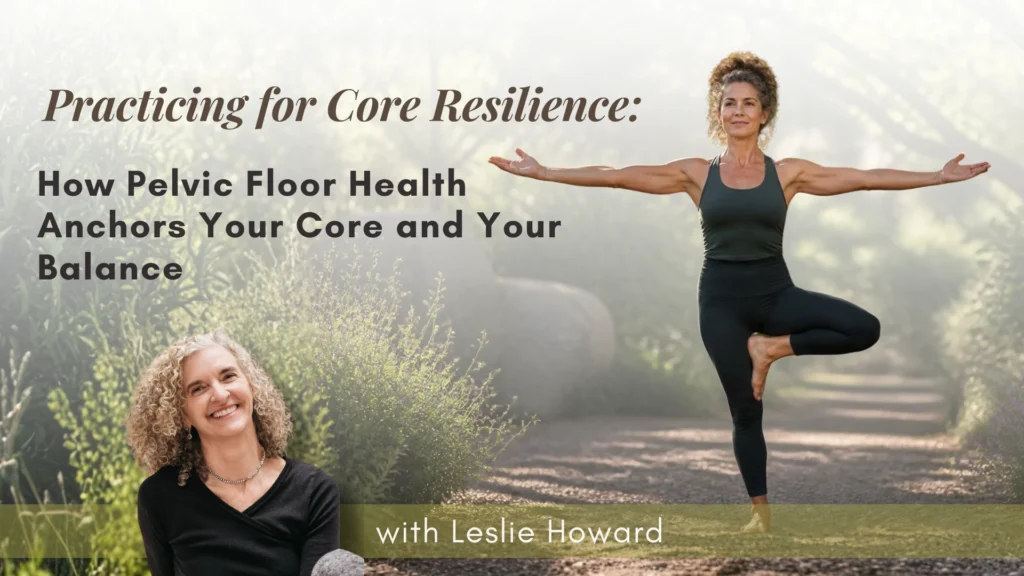
Most core training focuses on the muscles you can see — the abdominals, the back. But in this practice series, renowned yoga teacher and author Leslie Howard will help you develop the true foundation of core strengthening. Learn yoga practices to effortlessly and holistically engage and tone the pelvic floor muscles, the vital base of the pressure system that stabilizes your spine with every step you take.
What the Series Covers:
- Introduces the “the deep core” concept — diaphragm, deep abdominals, multifidus, and pelvic floor working together as a pressurized, coordinated system, not isolated muscles
- Explains why pelvic floor weakness or poor coordination (not necessarily “weakness” alone) can force the lower back to overcompensate, increasing strain and reducing efficient movement
- Connects this integrated core system to real-world stability — the same mechanism that lets you catch yourself on a stumble, lift something without strain, or maintain posture through a long day
- Honestly notes that isolated pelvic floor exercises alone aren't the answer — it's pelvic floor coordination with breath and the rest of the core system that matters
Join Us Live or View the Recordings!
September 17, 24, 29 & October 1, 2026
4 pm ET / 1 pm PT
