Revolved Half Moon Pose Twists From Your Upper Spine, Not Your Lower Back
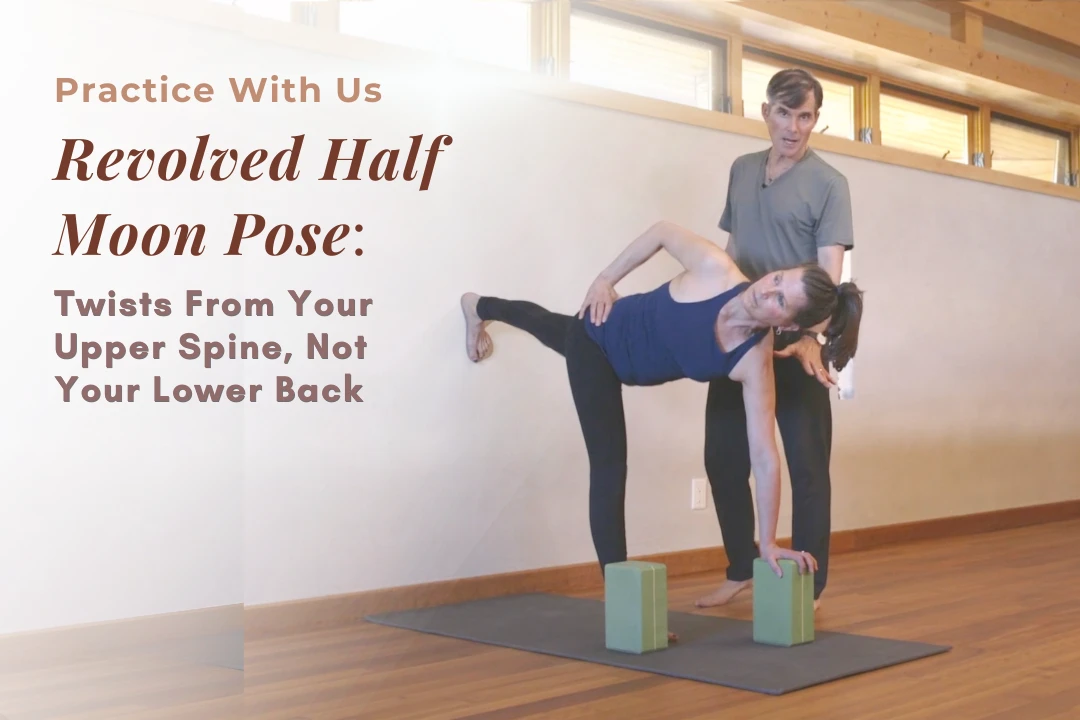
Revolved Half Moon Pose (Parivrtta Ardha Chandrasana) asks a lot of you at once: balance on one leg while twisting your torso open to the side. Because it feels so demanding, many of us go looking for the twist in the easiest place to find it, which is the lower back. That is exactly where the pose can start to feel strained. The good news is that the rotation was never meant to live there. It belongs higher up, in your upper spine, and that single shift changes everything.
Where Revolved Half Moon Pose Actually Twists
Picture your spine in two parts for a moment. The lower back is built mostly for stability, while the mid-back, your thoracic spine, is designed to rotate. When you twist from the thoracic spine, the movement is safe, spacious, and sustainable. When you torque from the lower back or hips instead, you lose both the length and the protection the pose depends on. So the goal is to keep your hips relatively stable and let your ribs and upper back do the turning. As a result, the twist feels open rather than forced, and your lower back stays comfortable throughout.
How Tias Builds Revolved Half Moon Pose in This Practice
In this tutorial, Tias Little walks you through Parivrtta Ardha Chandrasana one component at a time. First, you will set your standing leg foundation and find your hip stability, with a block under your bottom hand for support. Then he introduces the rotation, guiding you to open your chest toward the side while your hips stay steady. Importantly, he teaches the wall-supported variation, which gives you feedback and security so you can explore the twist without fear of falling. Along the way, he covers hand placement, gaze direction, and how to keep your spine long as you turn.
Complex Poses, Built From Their Parts
Here is the principle worth carrying beyond this pose. A challenging posture is not something you simply attempt and hope to land. Rather, it is something you build, understanding each element before combining them. So when you learn the balance, the hip stability, and the thoracic twist separately, the full pose stops feeling impossible. It becomes learnable, one clear piece at a time.
Watch Tias Little guide you through the full tutorial below.
Ready to explore this pose with confidence? Subscribe to our YouTube channel for more advanced tutorials that break challenging postures into achievable steps.