Extended Hand-to-Toe Pose: How to Build Toward Full Expression Without Losing Your Balance
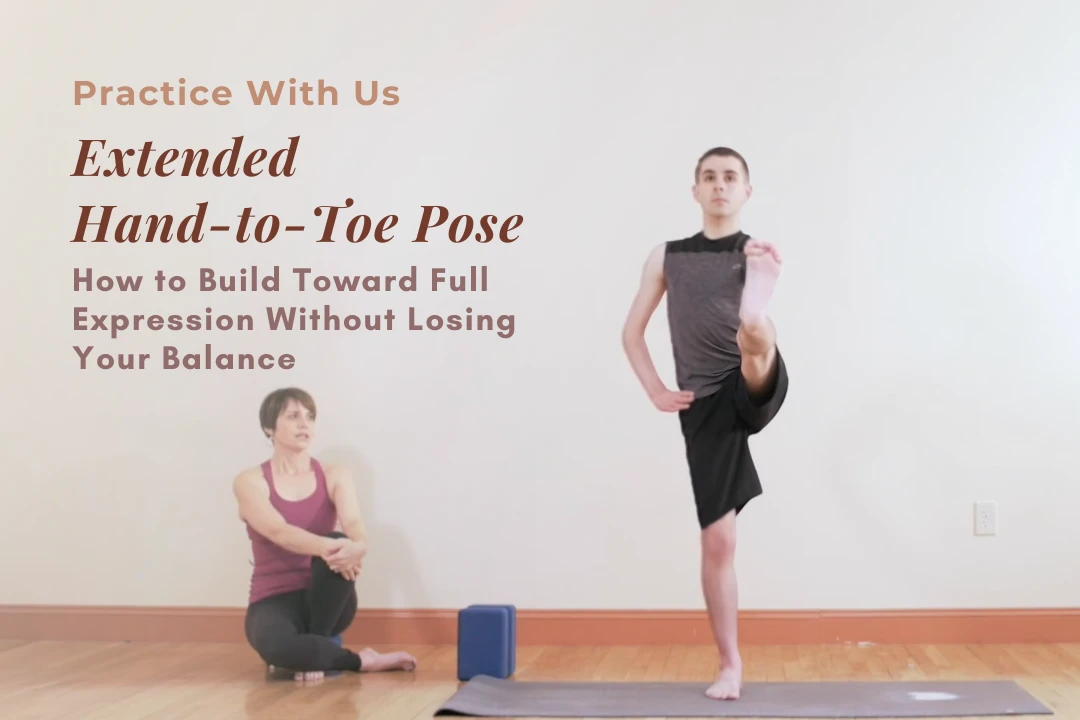
Extended Hand-to-Toe Pose is one of those poses that tends to collapse the moment you attempt it — the standing leg wobbles, the hamstring resists, and the effort of trying to hold it all together at once leaves you hopping around the mat wondering what went wrong. The difficulty isn't a flexibility problem or a balance problem in isolation. It's that the pose asks for both simultaneously, and most approaches to teaching it treat that as a single challenge to muscle through rather than two distinct skills to develop in sequence.
The insight that changes how this pose feels is simple: balance has to come first. Before your hamstrings are involved, before your leg begins to extend, your standing body needs to find its center and settle there. Tree Pose isn't just a warm-up for Extended Hand-to-Toe — it's the first stage of the same pose. When you establish your single-leg foundation with your knee bent and open to the side, you're doing the most important work of the whole progression. Everything that follows is an addition to something already stable, which is an entirely different experience than trying to build stability and flexibility at the same time from scratch.
How to move into extended hand-to-toe pose
In this tutorial, Karen Fuhrman guides you through Utthita Hasta Padangusthasana as a true progression, not a pose with modifications bolted on. You begin in Tree Pose, taking the time to genuinely find your balance before anything changes. From there, Karen teaches you to draw your knee forward toward your chest, hook your big toe with your peace fingers, and pause — because holding your toe with your knee bent is already the pose, complete in itself, not a stepping stone to something more legitimate.
For those ready to go further, she walks you through pressing through the heel while drawing the toes back to begin extending the leg, and eventually the option of taking it out to the side for the full expression. A strap around the foot opens the same progression to anyone whose hamstrings aren't yet ready to meet the hand. Throughout, Karen's sequencing makes clear that what determines how far you go isn't how flexible you are today — it's how honestly you build from where you actually are.
What this approach gives you is something more valuable than the full pose: a reliable method for developing it. Each time you practice this progression with patience, you're training both the balance and the hamstring length that the full expression requires, without the instability that comes from rushing ahead of your foundation.
Watch Karen Fuhrman guide you through the full tutorial below.
If you want to keep building standing balance skills through progressions that actually make sense in your body, subscribe to the channel — there's a whole library of tutorials that show you how intelligent sequencing gets you further than forcing ever will.