Bridge Pose: How Two Blocks Unlock Safe, Effective Backbending (Setu Bandha Sarvangasana)
Bridge Pose (Setu Bandha Sarvangasana) has a reputation as an accessible backbend gentle enough for beginners, useful enough for experienced practitioners. But if you've ever felt a familiar pinch in your lower back as you lift, you've encountered the problem that makes this pose more complicated than it looks. The issue usually isn't the pose itself. It's which muscles are doing the work. In bridge pose, most people let the glutes take over. When that happens, the lower back compresses, the hamstrings disengage, and the pose stops being therapeutic and starts being risky.
How Two Blocks Transform Your Bridge Pose Alignment
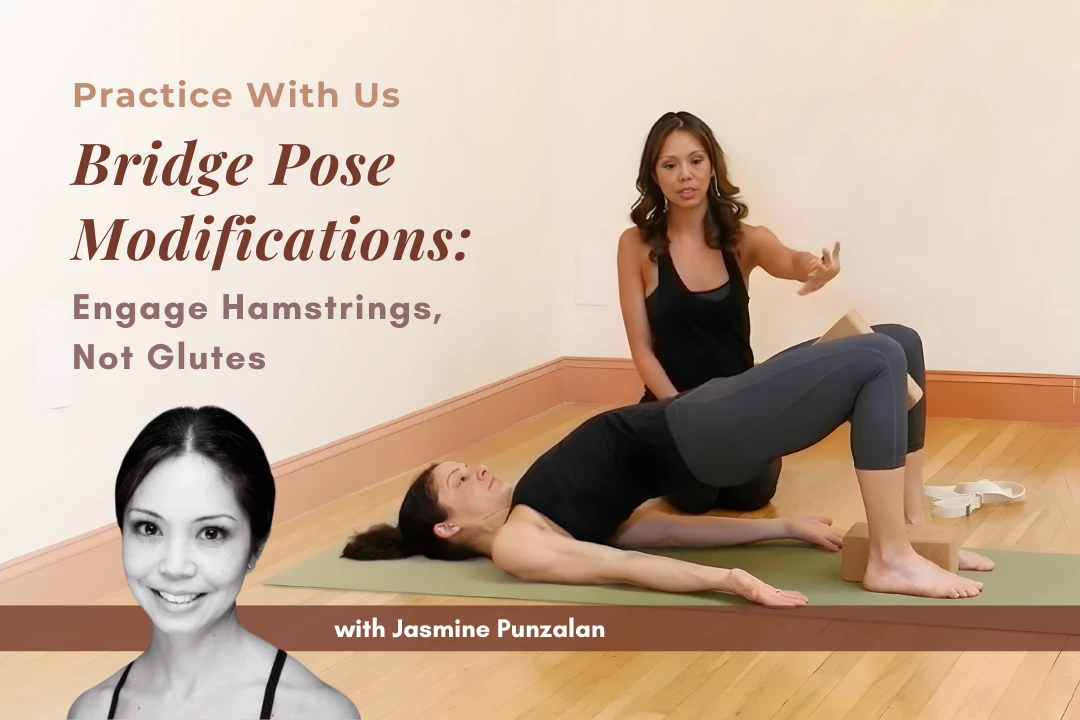
This is where props change everything — not as a modification, but as a tool for correct muscle engagement. Jasmine Punzalan's tutorial introduces a precise two-block setup that most practitioners have never tried. One block goes between your feet with big toes touching, preventing the feet from splaying outward. The second block sits between your thighs, keeping your legs parallel and stopping your knees from falling open. Together, these two placements do something subtle but powerful: they take the glutes out of the driver's seat in bridge pose and ask the hamstrings to engage instead. That shift is what protects the lower back. It's also what makes the pose genuinely strengthening rather than just effortful.
Jasmine adds one more detail that transforms how the pose feels. She cues an isometric action — sliding your feet back without actually moving them. That internal effort activates the hamstrings in a way that passive positioning alone never achieves. She also addresses the cervical spine, a part of the body most bridge pose instructions overlook entirely. Keeping the natural curve of your neck rather than flattening it into the floor is a small adjustment with real consequences for how the pose loads your upper back and shoulders.
Why Bridge Pose Is One of the Best Hip Flexor Stretches You're Not Thinking About
There's a broader benefit worth understanding here. Your hip flexors spend most of the day shortened — compressed by hours of sitting, driving, and forward-facing movement. Bridge Pose brings them into extension, which is the opposite of everything they've been doing. That lengthening along the front of the spine is one of the pose's most valuable effects. Done with proper alignment, bridge pose is also one of the most sustainable ways to build back-body strength over time.
Watch Jasmine Punzalan guide you through the full tutorial below.
If precise, anatomy-informed teaching is what keeps your practice sustainable, the YogaUOnline YouTube channel has more of it. Subscribe to keep learning how alignment details make the poses you already know work harder for you.