Backbends for Beginners (Setu Bandhasana): Building Spinal Extension Without Straining Your Lower Back
If backbends have ever left your lower back tight or uncomfortable, the instinct is to back off. You assume your spine just isn't built for that kind of movement. But the discomfort usually isn't coming from the backbend itself. It's coming from where the movement starts.
Backbends for Beginners: How Pelvic Awareness Changes Everything
Before your spine can extend safely, your pelvis has to move first. When you curl the tailbone in, the lower back softens instead of compressing. That small action — a posterior pelvic tilt — is what creates the foundation every backbend needs. Without it, the lumbar spine absorbs all the load. With it, the extension travels through the whole spine evenly. The pose opens rather than strains.
In this tutorial, Claudine Beeson builds that understanding from the ground up. She begins with three Bridge Pose variations, each one adding a layer. The first establishes pelvic initiation. The second introduces the image of squeezing a beach ball between the knees. That cue wakes up the outer leg lines and gives your hips significantly more lift. The third uses a yoga strap looped around the ankles. The moment you hold the strap, your shoulders drop, your neck lengthens, and your heart rises higher than it could on its own. Props here aren't a shortcut. They're what makes the full expression of the pose available to you.
Building From the Floor Up
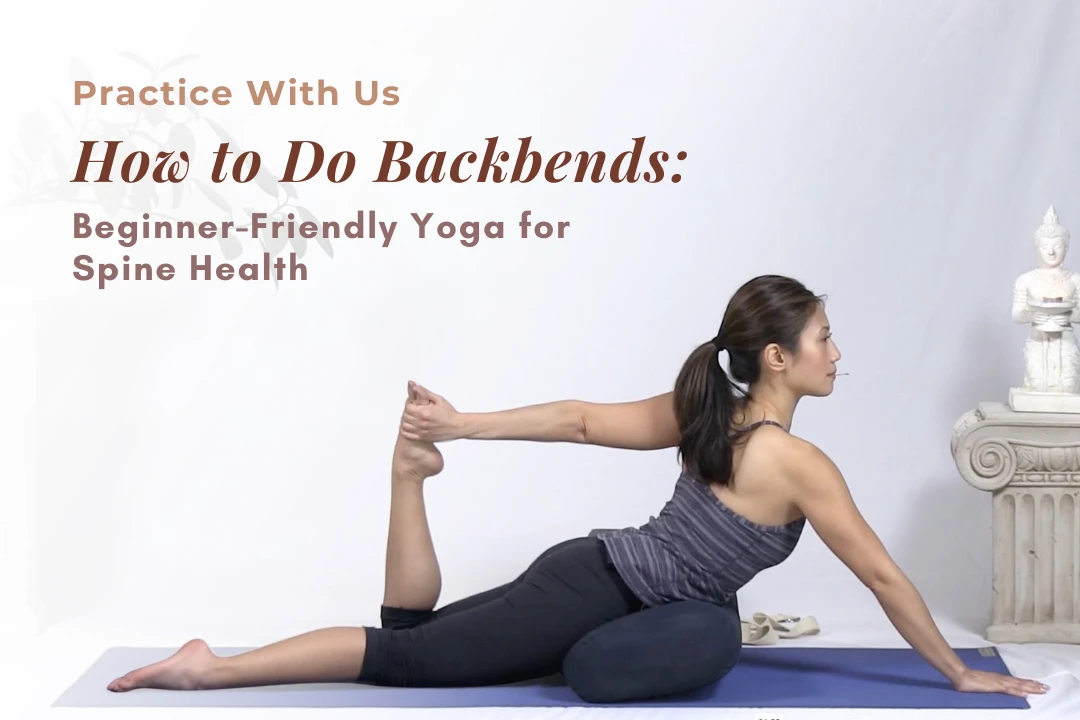
From Bridge, Claudine moves the practice to the floor. A bolster supports a series of chest openers that would otherwise demand more back strength than most beginners have developed. She layers the work carefully — breath awareness first, then gentle head and leg lifts, then a supported Sphinx. A one-legged variation follows, opening the front of the chest with control. Child's Pose appears twice as a deliberate reset. It gives your spine time to absorb what just happened before asking it to go further.
What this practice gives you isn't just a sequence to follow. It's a way of understanding how your spine works — so that every backbend you take on from here starts from the right place.
Watch Claudine Beeson guide you through the full tutorial below.
If this approach to building a safe, intelligent backbend practice resonates with you, subscribe to the YogaUOnline YouTube channel. New tutorials go up regularly — each one designed to help you move with more understanding and less guesswork.