The Shoulder and Hip Flexor Connection That Unlocks Your Warrior Poses
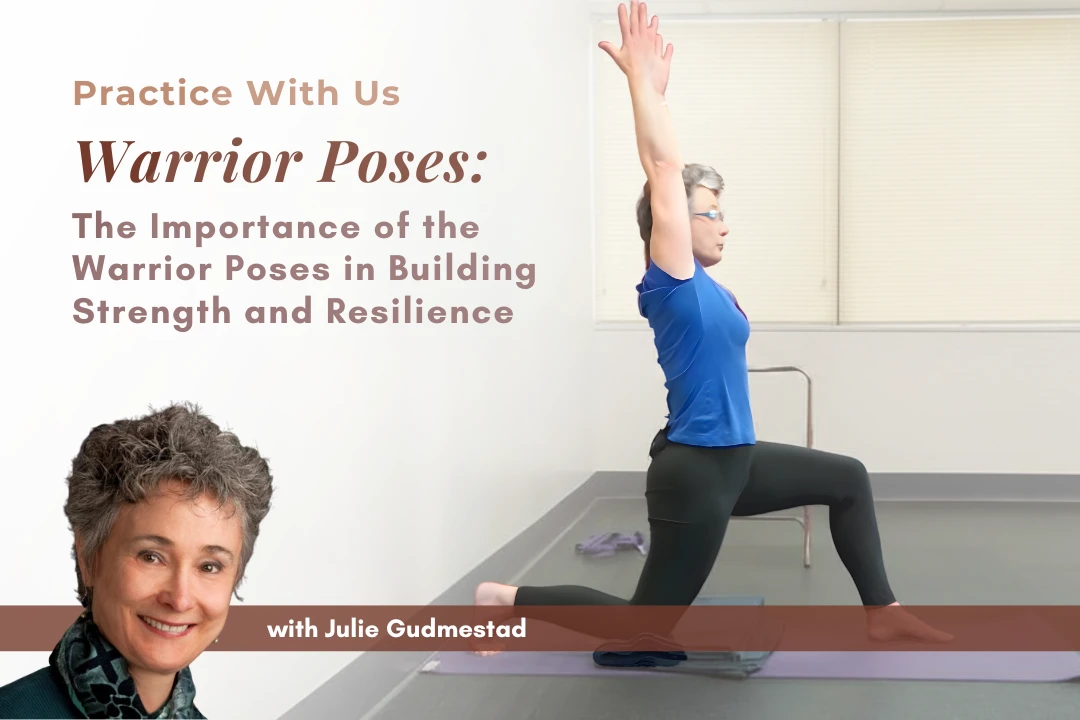
Most practitioners think of warrior poses as leg work. You plant your feet, bend your front knee, and hold. Yet if you've ever felt your lower back gripping in Warrior One (Virabhadrasana I) or your arms drifting forward in Warrior Three (Virabhadrasana III), your legs aren't the problem. The real limits in warrior poses live higher up — in tight shoulders and hip flexors that quietly pull your spine out of alignment before you even settle into the shape.
How Warrior Poses Reveal What Your Shoulders and Hips Can't Yet Do
When your shoulder muscles are restricted, lifting your arms overhead forces your lower back to compensate. The lumbar spine arches to get your arms vertical — and what feels like a strong backbend is actually compression. Similarly, when your hip flexors are tight, your pelvis tips forward in the lunge, shortening the very space your low back needs. Neither problem is visible from the outside. Both create the same result: a pose that strains instead of strengthens.
Julie Gudmestad approaches warrior poses as the endpoint of a preparation sequence, not the starting point. Her practice targets the specific restrictions that undermine both poses before you ever step into them.
What Julie Covers: Opening the Right Places First
Julie begins with passive and active shoulder openers at the wall. These teach your arms to reach fully overhead without recruiting your lumbar spine. You'll feel the difference immediately — suddenly your arms can lift without your back gripping to help them.
From there, the practice moves into hip flexor work in low lunge and a supported Warrior One using a doorway. Holding at the doorframe lets you feel the pelvis lift without the effort of balancing. That lift — the front of the pelvis drawing upward — is the action that protects your low back in both warrior poses.
Hamstring preparation using a ledge follows, building the posterior chain engagement Warrior Three depends on. Then Julie walks you through step-by-step transitions between Warrior One and Warrior Three with support, so the alignment you built in preparation carries into the full expression of the pose.
Props throughout — a yoga belt, a wall, a ledge — aren't shortcuts. They're the tools that let your body learn the correct patterns before you have to hold them independently.
The Poses Get Deeper When the Foundation Gets Smarter
Warrior poses are often cued as tests of endurance. Hold longer. Go lower. Push through the burn. But that approach reinforces exactly the compensations that create low back strain. When your shoulders open fully and your hip flexors release enough to let your pelvis neutral, the poses stop being a battle. Strength builds from alignment, not in spite of its absence.
Watch Julie Gudmestad guide you through the full tutorial below.
For more practices that build real strength through smart preparation, subscribe to the YogaUOnline YouTube channel — where functional alignment meets every level of practice.