Child’s Pose (Balasana) Is a Rest Pose — Until You Learn What Your Hands Are Actually Doing
Child's Pose has a reputation problem. Most practitioners treat it as a pause between harder things — a place to catch your breath, reset, and wait until the real work resumes. But child's pose, practiced with attention to what your hands and arms are doing, is anything but passive. It's where your shoulders learn the actions that make weight-bearing poses safe. And if you've ever felt pinching or strain in Downward Facing Dog, there's a good chance the lesson your shoulders needed was waiting here all along.
What Child's Pose (Balasana) Is Actually Teaching Your Shoulders
The hand position most people use in Child's Pose — arms stretched forward, wrists turned slightly in, weight settling wherever it lands — quietly reinforces the very pattern that causes shoulder problems later. When your wrists rotate inward, your upper arm bones follow. Your pectorals tighten. Your shoulder joints compress. None of this feels dramatic in a resting pose. But take that same pattern into Downward Dog or Plank, and your shoulders are already working against themselves before you've done anything difficult. The fix isn't complicated. It starts with where your hands are and what they're doing.
How Jasmine Punzalan Builds the Pose From the Ground Up
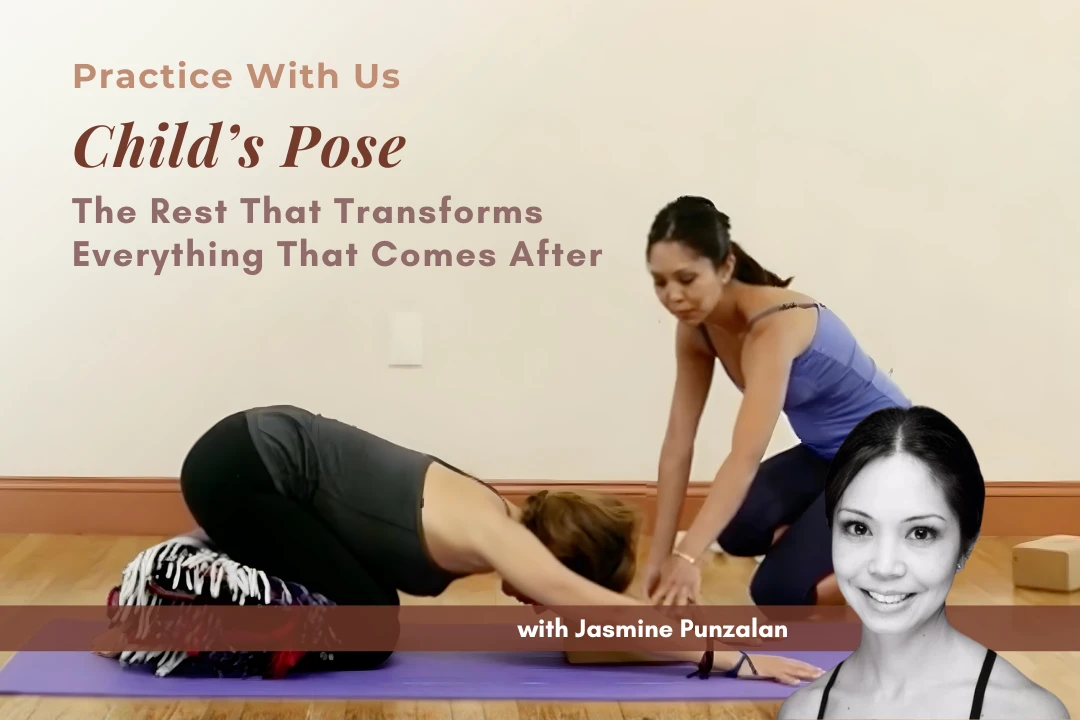
Jasmine begins with setup — and the details here matter more than they appear to. Big toes touch, knees open slightly wider than hips, torso rests on thighs. If your knees are sensitive, a folded blanket at the back of the knee joint changes everything. If your forehead doesn't reach the floor comfortably, a block or folded blanket brings the floor to you. Neither adjustment is a workaround. Both allow your body to actually release rather than brace against discomfort.
From there, Jasmine moves into the shoulder work at the heart of this tutorial. Hands come to shoulder-distance apart, middle fingers aligned with the centers of your shoulders. Wrist creases run parallel to the front edge of the mat — not angled in. From that foundation, you root down through the base of your thumb and index finger, then spin your inner upper arms toward the ceiling. That last action — inner arms lifting — is the same one your shoulders need in Downward Dog, in Plank, in any pose where your arms bear weight. Child's Pose is where you can feel it clearly, without the challenge of holding yourself up.
The Pose That Prepares You for Everything After It
What changes when you practice Child's Pose this way isn't just the pose itself. It's what becomes available next. Your shoulders arrive at weight-bearing poses already organized. The strain that used to show up in Downward Dog has less ground to take hold. Rest and preparation turn out to be the same thing — which is exactly what makes this pose worth returning to with full attention, every single time.
Watch Jasmine Punzalan guide you through the full tutorial below.
If this kind of precise, anatomy-informed teaching resonates with you, Jasmine has more where this came from. Subscribe to the YogaUOnline YouTube channel to keep building a practice that works with your body — not against it.