There’s an old joke about a man searching for his lost keys under a streetlamp. A passerby stops to help, and after several minutes of fruitless searching asks, “Are you sure you dropped them here?”
“No,” the man replies, “I dropped them over there in the dark. But the light is better here.”
This seemingly absurd scenario perfectly captures what may turn out to be one of medicine’s most consequential blind spots in fracture prevention.
For decades, we’ve been measuring bone mineral density with DEXA scans, prescribing medications to strengthen bones, and focusing almost exclusively on osteoporosis as the primary culprit behind fractures in older adults.
We’ve been looking where the light is brightest‚ at bone density‚ because that’s what we can easily measure and treat.
But what if we’ve been searching in the wrong place? Or at least been missing important parts of the picture?
A New Paradigm for Fracture Prevention
Emerging research is starting to reveal a paradigm shift in our understanding of the factors that drive fracture risk‚ and hence prevention.
Yes, people with low bone density do have higher fracture rates. But that statistical relationship doesn’t necessarily mean weak bones are the the primary driver of those fractures.
It’s entirely possible‚ and even likely new research indicates‚ that other underlying factors are at play, factors that independently increase not just fracture risk, but importantly, also fracture outcomes.
Large-scale studies are now revealing that two factors‚ posture and frailty‚ emerge as independent, powerful predictors of fracture risk.
These aren’t just conditions emerging from osteoporosis. Research now suggests that they are primary drivers that operate through their own mechanisms.
And crucially, they offer important new avenues for prevention that go far beyond a narrow focus on bone density.
The Fracture Crisis: Why This Matters More Than Ever
The stakes could hardly be higher. Hip fractures alone affect over 300,000 Americans annually, and the consequences extend far beyond a broken bone.
Older adults who suffer a fracture, particularly a hip fracture, face significantly higher risk of mortality and complications, including second fractures, leading to disability and loss of independence.
Around twenty to thirty percent of patients die within a year of a hip fracture, with some studies citing up to 36% mortality for hip fractures specifically. (1)
But death isn’t the only concern. Fractures frequently trigger a cascade of decline‚ loss of functional independence, chronic pain, and dramatically diminished quality of life. Together, all of these all too often pave the way to the nursing home. (2)

Source: Open Access Government
Given these grim statistics and the immense cost to human life and society resulting from the fall-out from fractures in people over 65, there are many good reasons for the widespread focus on fracture prevention.
We screen religiously with DEXA scans. We prescribe osteoporosis medications to slow bone loss. We counsel patients about calcium and vitamin D. Yet, there is no consistent research showing that we are making in-roads in fracture prevention in the 65+ year old.
And most signficiantly, when fractures do happen, the fall-out from fractures in the 65+ population varies widely from person to person.
Some people recover easily within a few months and are back to full activity within 6-12 months. Others develop chronic pain and/or lose their ability to function independently. And yet others develop severe complications and die within a short time of the fracture.
The vast differences in how fractures affect people, research now suggests, means that there are other factors involved in fracture risk and consequences.
And new research indicates we’ve been missing several important factors driving fracture risk and outcomes.
A Missing Piece Hiding in Plain Sight: Your Posture
Let’s start with what you can see in the mirror. For years, we’ve observed that many older adults develop forward head posture and rounded upper backs‚ what doctors call hyperkyphosis or, in its advanced stages, “dowager’s hump.”
The medical assumption has been straightforward: Hyperkyphosis has been widely dismissed as a medical issue, because it was assumed that this postural change simply is a symptom of osteoporosis.
The clinical progression subscribed to was that weak bones lead to vertebral fractures, these fractures cause the spine to curve forward, and the curved spine is the visible result.
All neat and simple. Except it’s not the whole story. Not even close.
Over the past two decades, emerging research has painted an entirely different picture, suggesting that hyperkyphosis isn’t just a consequence of weak bones.
Rather, studies have found. hyperkyphosis is often present in people who don’t have osteoporosis and low bone density. And, it is often a primary driver of fracture risk and mortality in its own right‚ separate from bone density.
Hyperkyphosis affects 20-40 % of older adults and researchers now classify it as a “new geriatric syndrome” associated with physical frailty. (3) A landmark study of 596 women found that those with hyperkyphosis had 1.7 times higher fracture risk even when they had no vertebral fractures and normal bone density. (3)
Analyses confirmed that hyperkyphosis itself is an independent risk factor for fractures, not merely a marker of underlying bone problems.

The mortality data is equally striking. Studies tracking older adults for over a decade found that each standard deviation increase in forward curvature of the spine carried a 1.15-fold increased risk of earlier death‚ even after adjusting for bone density, existing vertebral fractures, and fracture severity. (4)
Research on older men found that increasing kyphosis was associated with 1.26 to 1.53-fold increased mortality risk. (5) A Japanese study found that people with mild and severe kyphotic postures showed mortality rates of 8% to 13% compared to just 5% in those with neutral posture. (6)
The Fall Connection: Why Poor Posture Enhances Fracture Risk
Here’s the crucial link: most fractures don’t happen spontaneously. They happen because someone falls. And postural changes are powerful predictors of falls.
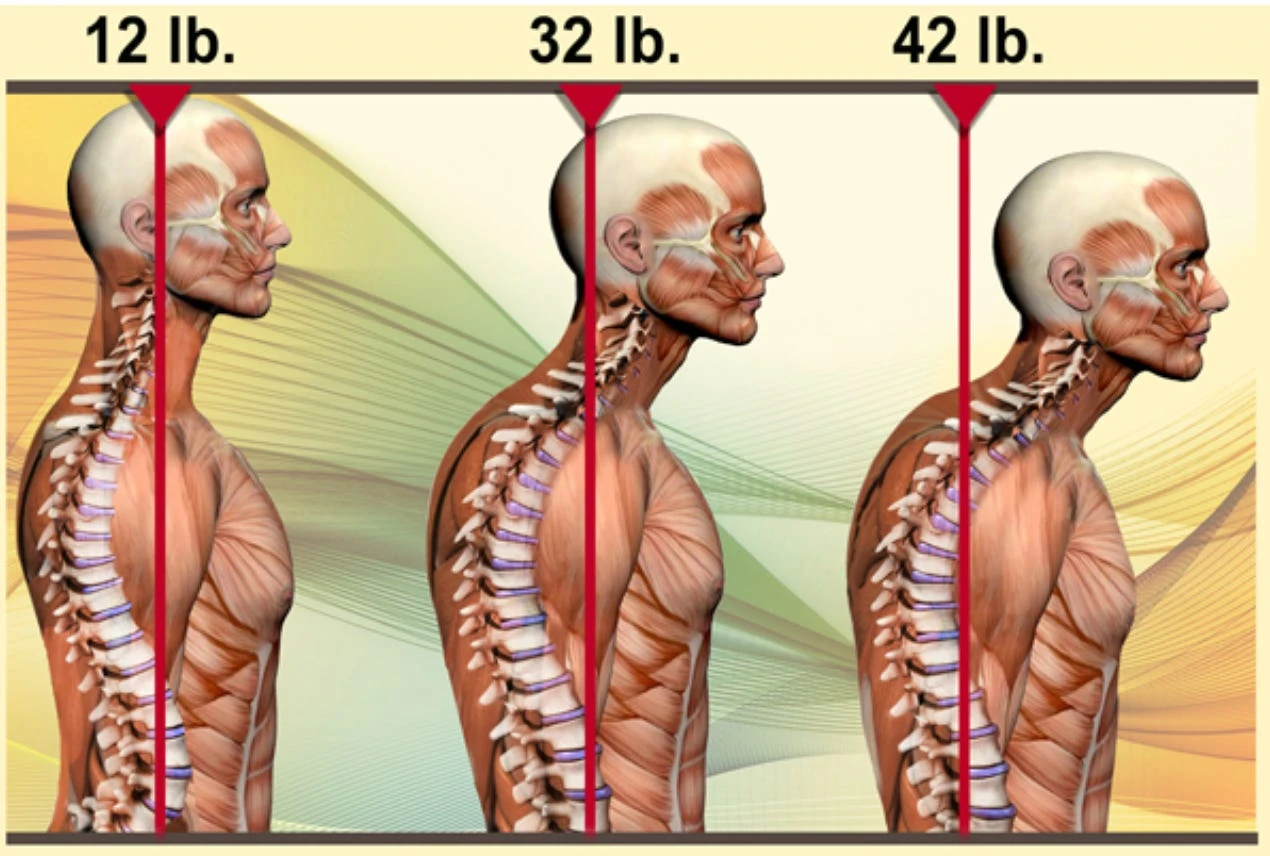
Why? When your head and upper back shift forward, your center of gravity shifts forward too. This creates an unstable situation where your body constantly has to work to keep you from toppling over. Your trunk muscles fatigue from the extra effort. Your balance becomes impaired. And your fall risk skyrockets.
A 2025 systematic review of nineteen studies found that hyperkyphosis significantly impairs both static and dynamic balance, with fall rates ranging from 24% to 64%‚ many resulting in injuries. (7)
The biomechanics are well-established: increased kyphosis shifts the body’s center of gravity forward, creating an augmented forward bending moment in the trunk. (8) The center of pressure moves forward, requiring increased trunk extensor muscle activity to maintain control, ultimately leading to greater body sway and instability. (8)
A comprehensive study tracking over 300 women with osteoporosis for more than five years found that spinal alignment was an independent risk factor for future fall-related fractures affecting all skeletal sites‚ not just the spine. (9) Poor posture doesn’t just increase risk of more vertebral fractures. It increases your risk of breaking your hip, your wrist, your arm.
People with hyperkyphotic posture demonstrate a cascade of functional problems: difficulty rising from a chair without using their arms, poorer balance, slower walking speed, wider stance when standing and walking, and decreased ability to climb stairs. (10) Each of these impairments increases fall risk, which increases fracture risk.
Understanding What Drives Postural Changes
If posture is such a powerful predictor, what makes it worse? One factor is the progressive loss of muscle mass and weight loss. (11) Each five kilograms of weight loss in some studies correlated with a one-degree increase in forward curvature. (12)
As older people lose weight, they lose muscle preferentially over fat. As core muscle support reduces, posture worsens. Older adults with hyperkyphosis show reduced trunk muscle strength and endurance, impaired trunk position sense, and weakness throughout their core and lower body. (13) The weaker your spinal extensor muscles, the worse your kyphosis tends to be. And the worse your kyphosis, the weaker those muscles become‚ a vicious cycle.
But it’s not just about increased fall risk. Research also shows that hyperkyphosis takes a serious toll on breathing. The forward curve reduces chest cavity space, restricts rib cage movement, and limits how deeply you can breathe.
A sixteen-year study found that kyphosis severity was associated with lung function decline comparable to light smoking‚ an excess loss of about 6 milliliters per year. (14) This respiratory compromise is one pathway through which posture affects mortality beyond just fracture risk. (15)
The Deeper Story: Frailty as the Underlying Driver
While deteriorating posture is visible and measurable, it’s actually emerging as part of a larger, more fundamental process:
Frailty.
While it sounds like just another adjective describing an older person, frailty is emerging as a new, medical syndrome and independent medical condition.
And when we look at frailty, we find an even stronger predictor of both a person’s fracture risk and of how well he or she recovers (or not) after a fracture.
Frailty is a syndrome characterized by decreased physiological reserve and vulnerability to stressors. (16) It’s not just about being weak or tired. It’s about your body’s overall capacity to handle challenges‚ whether that’s fighting off an infection, recovering from surgery, or simply maintaining your balance when you stumble.
And, some research suggests‚ frailty can be an independent predictor of fractures. A Swedish population study following everyone a group of 55+ year-olds five years made a surprising discovery: Hip fractures could be predicted accurately without using bone density measurements at all. (17) Frailty indicators‚ such as needing home-help services‚ were strong enough predictors on their own. (17)
And when combined with bone density measurements, frailt scores emerges as a much more powerful harbinger of fractures then just your DEXA scores.
A groundbreaking 2024 Korean study analyzing over 5,000 people revealed that when frailty scores were combined with bone density measurements, fracture risk was predicted far more accurately than using either measure alone. (18)
Frail individuals showed dramatically elevated fracture risks: 2.1 times higher for any fracture, 2.5 times higher for vertebral fractures, and 2.5 times higher for hip fractures. (18)
When frailty and bone density were assessed together, the accuracy of predicting major osteoporotic fractures reached 82.5%‚ substantially better than either measurement by itself. (18)
The mortality statistics are equally compelling. In a major 2024 study, severely frail patients had 56 times higher two-year mortality compared to robust patients after hip fracture. (19) After a hip fracture, minimally frail patients had a 1.3% thirty-day mortality rate while severely frail patients face 14.6%. (20) At one year, those numbers become 3.8% versus 41.7%. (20) That eleven-fold difference isn’t about bone strength‚ it’s about your overall functional health and whether your body has the reserves to handle major stress.
When frail patients fracture, the real danger isn’t the broken bone itself. It’s that they don’t have the resilience to bounce back and to withstand the cascade of stress that follows in the wake of a fracture.
A Swedish nationwide study found that in a group of people with fractures, those who were frail had triple the risk of heart and lung complications and a five times increased risk of multi-organ after hip fracture surgery. (21) A 2025 study found that elderly hip fracture patients who developed multiple organ dysfunction had thirty-day mortality rates reaching 50%. (22)
The Frailty Trap: How the Cycle Perpetuates Itself
What makes frailty so insidious is that it’s self-reinforcing. Researchers have identified a clinical phenotype characterized by five key components: unintentional weight loss, exhaustion, low physical activity, slow walking speed, and weak grip strength. (16) When you have three or more of these, you’re considered frail.
But here’s the trap: each component makes the others worse. Loss of appetite leads to weight loss. Weight loss means losing muscle mass. Less muscle means more exhaustion with activity. Exhaustion leads to less movement. Less movement causes more muscle loss and slower walking speed. Weaker muscles mean weaker grip and more difficulty with daily tasks. And the cycle continues, spiraling downward.
Essentially, people get trapped in the “disuse syndrome”‚ a cascade where reduced activity leads to deconditioning, which leads to more activity avoidance, which leads to further deconditioning.
Importantly, it’s not laziness or giving up. It’s a physiological trap where the body’s declining capacity creates a feedback loop that accelerates the decline.
The connection to posture becomes clear here. Weak core and back muscles contribute to poor posture. Poor posture impairs balance and increases fall risk. Falls (or fear of falling) reduce physical activity. Reduced activity accelerates muscle loss. More muscle loss worsens posture. Round and round it goes.
What’s particularly important is that frailty often comes before fractures, not just after them. A comprehensive UK Biobank study tracking over 400,000 people for more than thirteen years found that frailty significantly increased fracture risk across all types‚ even in people without osteoporosis. (23)
A 2025 study found that people with multiple vertebral fractures showed 2.34 times higher odds of being frail even after accounting for age, sex, and body weight, with researchers noting that frailty may precede fractures rather than being solely a consequence of them. (24)
This bidirectional relationship is key: Frailty makes you more likely to fall and break bones through muscle weakness, impaired balance, and reduced coordination. Then breaking bones accelerates frailty by reducing mobility, increasing chronic pain, and causing further muscle loss.
Why Strength Training Alone Isn’t Enough
The good news is that the increased focus on osteoporosis has led to more emphasis on strength training for older adults‚ and that’s genuinely positive. Building muscle and bone through resistance exercise is important and has documented benefits for fracture prevention and so much more.

But strength training alone doesn’t address the full picture of fracture prevention.
You can have strong muscles and still have poor balance. You can lift weights and still have restricted breathing from thoracic kyphosis. You can be relatively strong and still have slow, cautious movement patterns that indicate underlying frailty. And for many deconditioned people, strength training often leads to injuries.
The Good News: Multiple Intervention Points
Perhaps the most empowering aspect of this research is what it reveals about prevention. Rather than having just one narrow target (bone density), we now understand there are multiple intervention points:
Posture is modifiable. A six-month trial of spine-strengthening exercise and posture training reduced both X-ray and clinical measures of kyphosis compared to control groups. (25) Long-term follow-up showed these benefits lasted‚ an average of three years after a three-month intervention, people maintained their improvements and their kyphosis didn’t progress as it typically does with age. (26) Systematic reviews suggest that targeted spinal extension exercises and mind-body practices like yoga can reduce kyphosis in older adults. (27)
Frailty is reversible. Studies show that multicomponent exercise programs can move people from frail to pre-frail or even robust categories. The key is addressing multiple components simultaneously‚ strength, balance, endurance, and functional movement.
The trajectory can change. Multiple validated, practical methods exist for measuring both kyphosis and frailty in clinical settings without requiring expensive imaging. Simple assessments like the blocks method for posture (counting how many small blocks you need under your head to lie flat) or frailty scales can identify people at risk early, when interventions are most effective. (28)
Start High: Keys to Building a Multi-Dimensional Fracture Prevention and Functional Fitness Approach
True movement longevity requires a more comprehensive approach. One that focuses not on one single dimension of fitness and one that emphasizes establishing high levels of functional fitness.
The key is to build your Movement Longevity to retain your capacity to stay mobile and avoid getting caught in the trap of increasing levels of disuse‚ either because you’re too tired, have achy joints, are recovering from an injury, — the list goes one and on.
But in most cases, the reason most of us are not working to shore up our Movement Longevity to stay clear of the disuse trap is because we simply haven’t to work comprehensively with our body to build our physical reserves efficiently and consistently.
This is a multi-dimensional focus that involves a focus on:
Postural awareness and alignment work‚ actively working to maintain or improve spinal position through targeted exercises that strengthen spinal extensors and promote thoracic extension.
Balance and proprioception training‚ not just static balance, but dynamic balance that challenges your ability to recover from perturbations and maintain stability through movement.
Flexibility and mobility‚ particularly thoracic spine mobility, hip flexibility, and ankle mobility, all of which contribute to better movement patterns and fall prevention.
Functional movement patterns‚ practicing the movements you do in daily life (getting up from chairs, reaching overhead, stepping over obstacles) to maintain the neuromuscular coordination these activities require.
Cardiovascular capacity‚ maintaining the aerobic fitness that prevents exhaustion and supports overall systemic health.
Nutritional adequacy‚ ensuring sufficient protein and calories to prevent the unintentional weight loss that drives both postural decline and frailty.
Social engagement and purposeful activity‚ combating the isolation and inactivity that can trigger the disuse syndrome.
The key is to start high, so if you do decline on the functional fitness scale, you can still retain enough movement capacity to stay active.
This is what it means to prevent frailty‚ not just building strength, but maintaining the full spectrum of physical capabilities that keep the body resilient and functional.
A regular therapeutic yoga practice for aging bodies is worth highlighting here, as it offers one of the best ways to stay high on the functional fitness ladder.
Primarily because in one practice, you can include most all of the approaches above to enhance your functional fitness and lay the groundwork for greater movement longevity. But that is a topic for another day.
Looking Where the Answers Actually Lie
The man searching for his keys under the streetlamp was looking in the wrong place‚ not because the light was bad, but because that’s not where he lost them.
Similarly, our decades-long focus on bone mineral density as the primary target for fracture prevention has given us valuable insights, but it’s been illuminating only part of the problem.
The evidence is now clear: bone density is one factor among several risk factors for fractures after the age of 65, and perhaps not even the most important one.
Posture assessment and frailty evaluation provide crucial information that bone density scans simply cannot capture. Someone with good bone density but poor posture and declining function faces significant fracture risk. Someone with modest bone loss but strong postural alignment, good balance, and robust functional capacity may have much lower actual risk.
For movement professionals, yoga teachers, and anyone working with aging populations, this research validates what many have long intuited: comprehensive movement practices that address posture, balance, strength, flexibility, and functional capacity aren’t just about quality of life‚ they’re primary prevention strategies for one of the most serious health risks facing older adults.
The paradigm shift we need is to expand our view beyond bone density scans to include functional assessments, postural evaluation, and frailty screening. We need to recognize that maintaining movement capacity isn’t just about preventing frailty‚ it’s about preventing the fractures themselves.
The keys to fracture prevention aren’t under the streetlamp of bone density alone. They’re in the interplay of posture, balance, functional movement, and overall resilience‚ areas where thoughtful, comprehensive movement practices have profound potential to change the trajectory of aging. We just need to be willing to look beyond where the light is brightest and start searching where the answers actually lie.