Posture Corrections for Back Pain: Your Back Gets Stronger When Your Chest Opens First
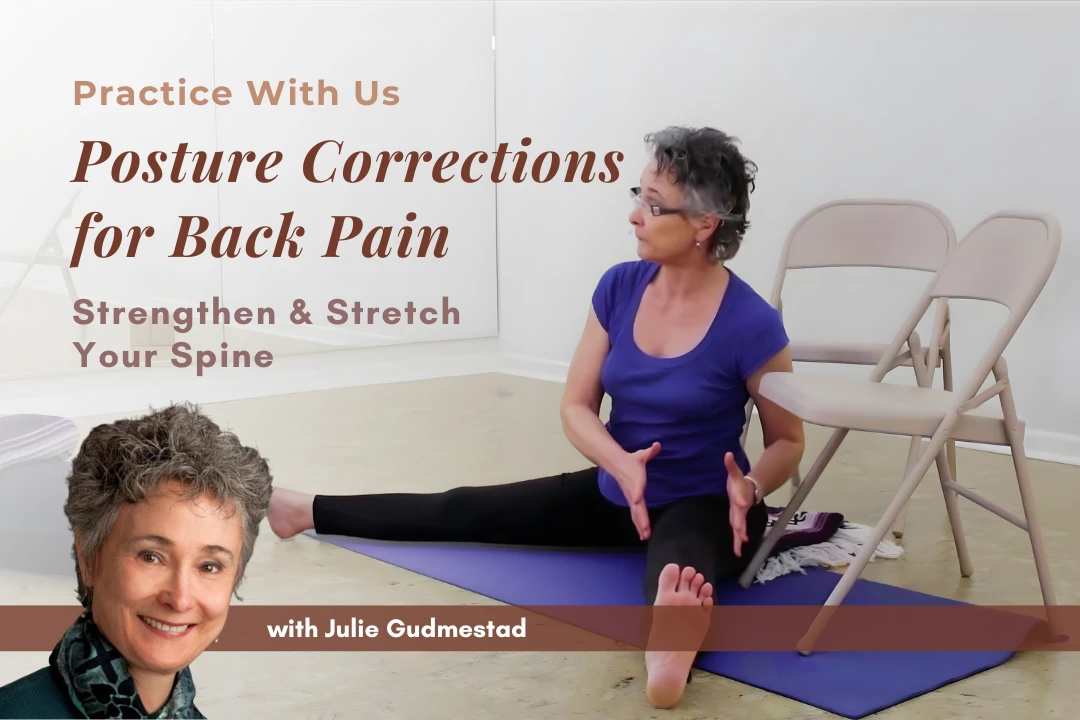
Most approaches to posture corrections for back pain start with the back — strengthening it, stretching it, trying to talk it out of hurting. But if the muscles across your chest and shoulders are chronically tight, your back muscles are already fighting an uphill battle. As a result, tightness in the front body pulls your posture forward. It also compresses your breath. Ultimately, it leaves your mid back unable to do its job. Releasing that tension first isn't a warm-up formality — it's what makes everything else work.
Posture Corrections for Back Pain: Why the Chest Comes First
Julie Gudmestad opens this practice with a simple prop setup most people have never tried. First, you roll a blanket lengthwise, place it along your spine, and lie back so both your tailbone and head are supported. Then your arms open to the sides, and gravity does the work. Soon, the pectoral muscles across your chest begin to soften. Your breath deepens without effort. What feels like rest is actually preparation — because once the front body releases, the back muscles can finally engage the way they're designed to.
Building Strength Where Your Back Needs It Most
From there, Julie guides you through Locust Pose and Cobra with a focus that might surprise you. The goal isn't height. Instead, staying low — just a few inches off the floor — keeps the work right in the mid back, where most people are weakest. She also walks you through Triangle Pose as a strengthener for the quadratus lumborum. This deep muscle runs between your pelvis and ribs and drives many back pain patterns. Specifically, the hip-hinge entry Julie teaches — hand at the crease of the thigh rather than at the waist — keeps the side body long. That's what makes the pose do its actual job.
Release Work That Lets the Back Unwind
After the strengthening, the practice shifts into release. Gentle knee swings, cat-cow, Child's Pose, and a diagonal Child's Pose variation all target the quadratus lumborum with quiet precision. For backs that are ready for more, Julie then introduces supported wide-leg forward bends and a chair-assisted side stretch. Together, these poses take the back through its full range of motion. No force. No strain. Every stretch earns its place.
Watch Julie Gudmestad guide you through the full tutorial below.
If your back has been asking for this kind of intelligent, layered attention, Julie's approach is worth staying close to. Subscribe to YogaUOnline on YouTube for practices that treat back health as the whole-body conversation it actually is.