Plank Pose: What Changes When Everything Works Together
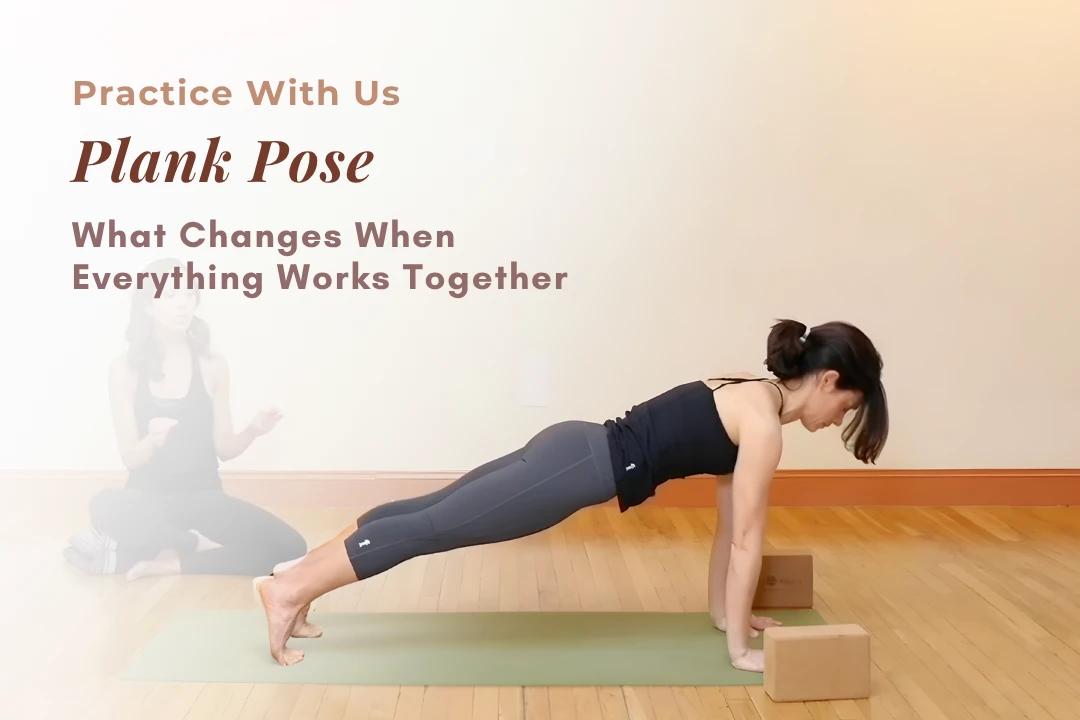
Plank Pose (Phalakasana) looks deceptively simple. Hold your body in a straight line. Support it on your hands and toes. Don't collapse. In faster-paced classes, it moves by in a breath — something you pass through rather than study. But the subtle engagements that make plank pose genuinely strengthening, rather than just effortful, are easy to miss at speed. And without them, the pose that's meant to protect the lower back is the one that strains it.
Plank Pose Alignment That Protects Your Lower Back
Hand placement is the first thing most practitioners overlook. In this tutorial, Jasmine Punzalan begins there — hands directly under the shoulders, fingers spread, weight traveling into the knuckle line rather than pooling in the heels of the hands. From that foundation, she teaches the arm action of pressing the floor away while broadening across the collarbones. This prevents the chest from sinking and, as a result, maintains the integrity of the entire upper body line.
The Core Engagement That Holds Everything Together
The critical engagement comes next: drawing the low belly in toward the spine. That single action keeps the hips level. Without it, gravity wins and the lumbar compresses. So rather than absorbing load, the lower back stays supported. Jasmine then adds leg engagement — thighs lifting, heels pressing back — and the head position that completes the line. For practitioners building toward the full pose, she also offers a knees-down modification. Because every alignment principle carries over, strength develops on a foundation of good form rather than compensation.
When the Pose Stops Feeling Like a Battle
Three common patterns work against you in plank: hips piking too high, shoulder blades collapsing toward each other, and breath held in an effort to survive. Jasmine addresses each one in turn. The pike pulls work away from the core. The shoulder collapse, meanwhile, disconnects the arms from the torso. Held breath increases tension without adding stability. Each correction restores how the pose is actually designed to work.
Plank isn't a test of how long you can endure. Instead, it's a full-body conversation happening in a single held shape. When the hands, arms, core, legs, and breath all participate, the pose stops feeling like a battle. That experience — everything working together — is what Jasmine's instruction makes possible. It applies every time you move through a vinyasa, every time you lower to the floor.
Watch Jasmine Punzalan guide you through the full tutorial below.
Jasmine's teaching has a way of making familiar poses feel entirely new. Subscribe to YogaUOnline for more alignment-focused tutorials that build resilient, intelligent strength from the inside out.